How to Correctly do Semantic Backpropagation on Language-based Agentic Systems
Due to the strength of Large Language Models (LLMs) in doing a wide array of tasks, agentic systems typically have most of their key components rely on querying LLMs. This results in communication between the components of such systems being handled with free-form natural language (Zhuge et al., 2023). However, while relying on LLMs does partially alleviate the engineering burden of building such systems, designing agentic systems remains nontrivial.
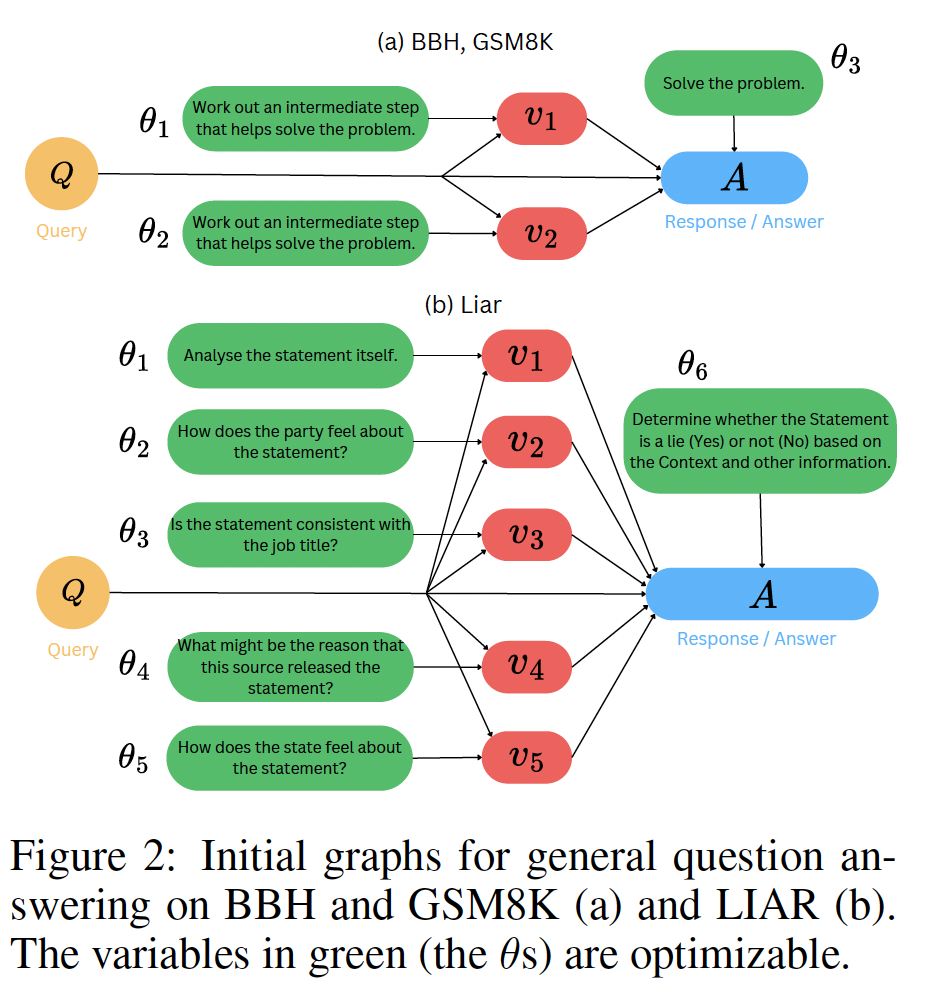
Task. In the LIAR dataset (Wang, 2017), the task is to decide whether a political statement is a lie or not. Each sample in the dataset consists of five attributes, i.e., (i) the statement, (ii) the political party of the speaker, (iii) the job title of the speaker, (iv) the state from which the speaker comes from, and (v) the source from which this statement is released. This five-attribute structure leads to an intuitive decomposition of the problem, where each component of an agentic system analyzes an attribute and then merges the analysis(Figure 2, b). This intuitive decomposition is desirable here as it allows for a relatively naive yet practically plausible agentic system architecture and prompts. Thus we can focus our evaluation on the performance of the optimizers. We use the binary classification version of LIAR as done by Pryzant et al. (2023).Here, the prefix of the response (required to be either “Yes” or “No”) is used to determine how the agentic system has classified a query.
Experiment Design. Following the aforementioned decomposition strategy, we optimize a graph of 13 variables, of which six are optimizable parameters. These six optimizable parameters serve as instructions for an LLM. Five are initialized to guide the LLM in analyzing specific attributes of a sample, while the last parameter instructs the LLM to formulate a final answer based on the previous analyses. See Figure 2 for the visualization of the initial graph.
We compare our optimization method with four variants: (1) optimizing without semantic gradients by removing the feedback (see Implementation 1) as input of the parameter update function; (2) optimizing one parameter only (running this variant six times with a different parameter each time and reporting the average); (3) optimizing with semantic gradients computed without conditioning the neighborhood (i.e., as in Equation (3)), emulating TextGrad in our implementation; and (4) optimizing without the update gate introduced in Section 3.2, where update gate accepts parameter updates only if they performs better on a validation set.
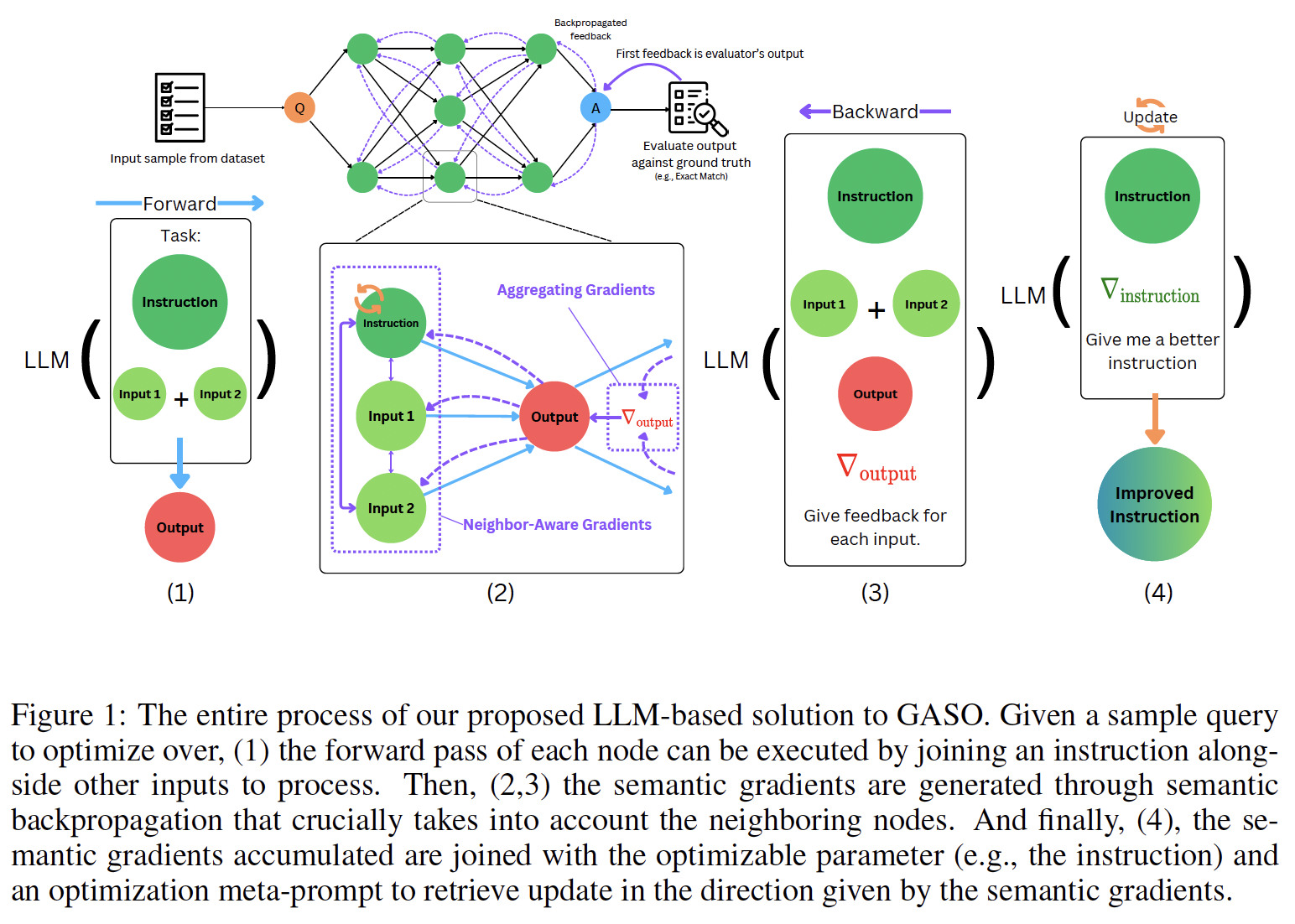
In this work, we tackled the challenge of optimizing language-based agentic systems by introducing semantic gradients and semantic backpropagation. These concepts generalize existing credit assignment methods, such as reverse-mode automatic differentiation and TextGrad, by incorporating neighborhood conditioning to compute directional information which can be leveraged to improve each optimizable component of the system. This framework enabled us to propose semantic gradient descent, effectively solving the Graph-based Agentic System Optimization (GASO) problem.
Lines of inquiry this paper opens 24
Research framings built by reading the notes related to this paper — the questions it feeds into.
When and why do multi-agent systems outperform single-agent models? Why do agents report success despite actually failing at their tasks?- How should credit be assigned to individual agents in failing multi-agent runs?
- Can agents diagnose their own errors better than they diagnose subagent failures?
- Can AI self-correct its way out of epistemic circularity?
- Why does self-critiquing actually reduce plan quality in language models?
- Does self-revision actually improve reasoning in large language models?
- What are the three root causes models fail at self-correction?
- Why does external verification stop error amplification but internal self-assessment enable it?
- Why does self-revision degrade reasoning accuracy in o1-like models?
- How does self-revision on wrong answers increase model confidence further?
- Does self-conditioning improve belief-behavior alignment better than external priors?
- Why does online RL succeed where supervised training fails for self-correction?
- How does distribution mismatch between training and deployment break self-correction?
- What makes deliberate practice on your own errors more effective than copying others?
- Why does self-generated training data outperform externally sourced data?
- Can self-distillation reduce catastrophic forgetting in continual learning?
- Can models learn better from critiquing errors than imitating correct responses?
- Why does self-generated training data outperform externally curated domain examples?
- Can AI-generated explanations of errors teach as effectively as self-resolution?
- Can self-consistency checks fully prevent error avalanching in self-training loops?
- How does self-distillation differ from standard fine-tuning approaches?
- Can models learn to generate their own training examples effectively?
- Why does self-correction during generation produce reliable labels without exemplars?