Large Language Model-Brained GUI Agents: A Survey
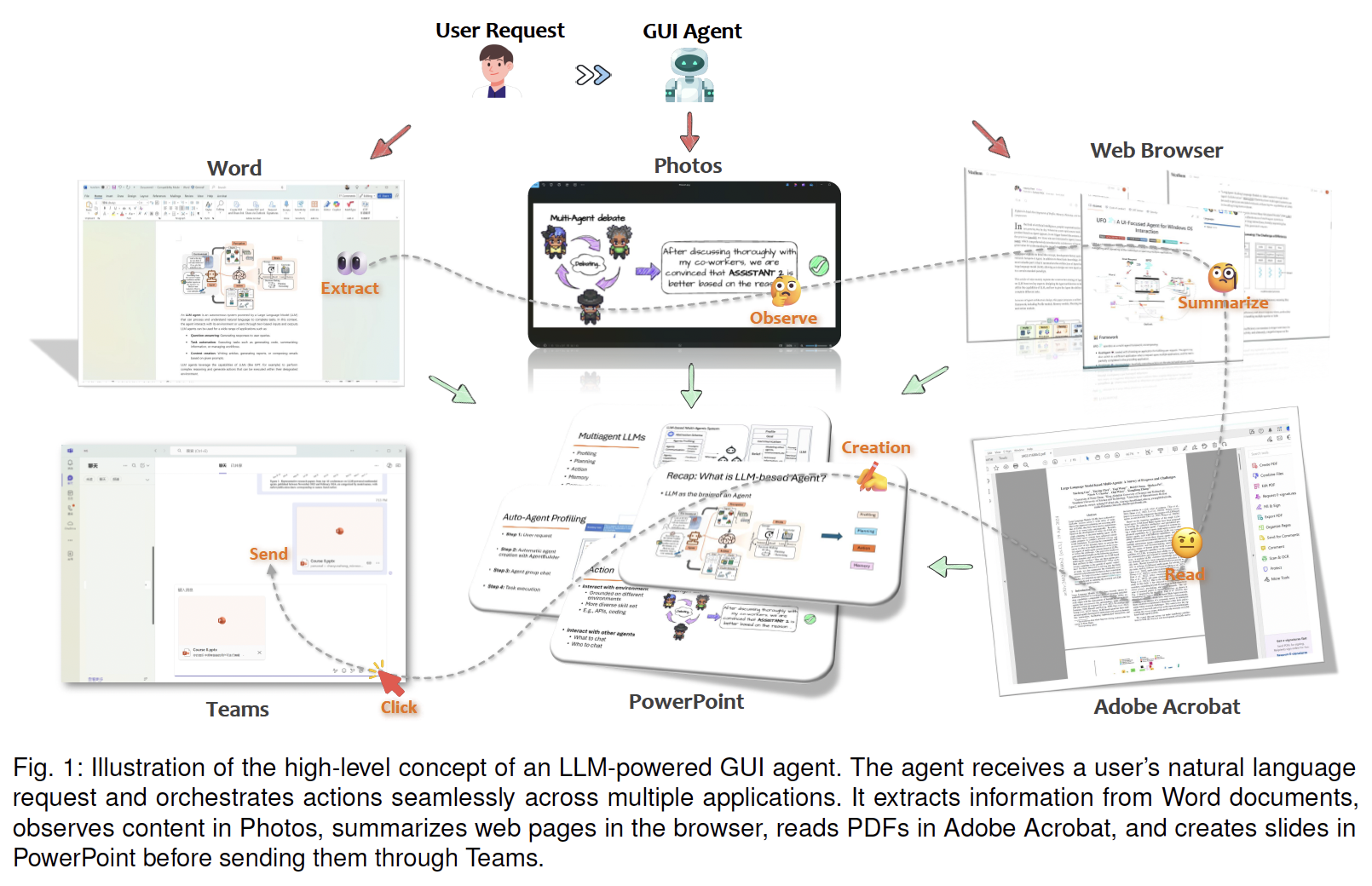
Abstract—Graphical User Interfaces (GUIs) have long been central to human-computer interaction, providing an intuitive and visually-driven way to access and interact with digital systems. Traditionally, automating GUI interactions relied on script-based or rule-based approaches, which, while effective for fixed workflows, lacked the flexibility and adaptability required for dynamic, real-world applications. The advent of Large Language Models (LLMs), particularly multimodal models, has ushered in a new era of GUI automation. They have demonstrated exceptional capabilities in natural language understanding, code generation, task generalization, and visual processing. This has paved the way for a new generation of “LLM-brained” GUI agents capable of interpreting complex GUI elements and autonomously executing actions based on natural language instructions. These agents represent a paradigm shift, enabling users to perform intricate, multi-step tasks through simple conversational commands. Their applications span across web navigation, mobile app interactions, and desktop automation, offering a transformative user experience that revolutionizes how individuals interact with software. This emerging field is rapidly advancing, with significant progress in both research and industry.
Introduction. Graphical User Interfaces (GUIs) have been a cornerstone of human-computer interaction, fundamentally transforming how users navigate and operate within digital systems [1]. Designed to make computing more intuitive and accessible, GUIs replaced command-line interfaces (CLIs) [2] with visually driven, user-friendly environments. Through the use of icons, buttons, windows, and menus, GUIs empowered a broader range of users to interact with computers using simple actions such as clicks, typing, and gestures. This shift democratized access to computing, allowing even non-technical users to effectively engage with complex systems. However, GUIs often sacrifice efficiency for usability, particularly in workflows requiring repetitive or multi-step interactions, where CLIs can remain more streamlined [3]. While GUIs revolutionized usability, their design, primarily tailored for human visual interaction, poses significant challenges for automation.
Discussion / Conclusion. LLM-brained GUI agents hold significant promise for automating complex tasks and enhancing user productivity across various applications. However, realizing this potential requires addressing the outlined limitations through dedicated research and development efforts. By addressing these challenges, the community can develop more robust and widely adopted GUI agents. Collaboration among researchers, industry practitioners, policymakers, and users is essential to navigate these challenges successfully. Establishing interdisciplinary teams can foster innovation and ensure that GUI agents are developed responsibly, with a clear understanding of technical, ethical, and societal implications. As the field progresses, continuous evaluation and adaptation will be crucial to align technological advancements with user needs and expectations, ultimately leading to more intelligent, safe, and user-friendly GUI agents.