ACE: Abstractions for Communicating Efficiently
A central but unresolved aspect of problem-solving in AI is the capability to introduce and use abstractions, something humans excel at. Work in cognitive science has demonstrated that humans tend towards higher levels of abstraction when engaged in collaborative task-oriented communication, enabling gradually shorter and more information-efficient utterances. Several computational methods have attempted to replicate this phenomenon, but all make unrealistic simplifying assumptions about how abstractions are introduced and learned. Our method, Abstractions for Communicating Efficiently (ACE), overcomes these limitations through a neurosymbolic approach. On the symbolic side, we draw on work from library learning for proposing abstractions. We combine this with neural methods for communication and reinforcement learning, via a novel use of bandit algorithms for controlling the exploration and exploitation trade-off in introducing new abstractions.
Humans use abstractions in many procedural tasks such as cooking, building shapes, and programming. In a seminal paper by Ho et al. (2019) that combines perspectives from Cognitive Science, AI and reinforcement learning, it is argued that abstractions guide learning, facilitate trade-offs, and simplify computation. They identified an outstanding open problem that “future work in both computer science and psychology will need to identify other pressures that can shape abstraction learning – such as the need to communicate and coordinate with others”. We carry out the first steps to solving this problem in the setting of cooperative artificial agents. When presented with the opportunity for repeated interaction, human conversational partners tend towards more concise utterances (Hawkins, Frank, and Goodman 2020; McCarthy et al. 2021; Krauss and Weinheimer 1964). This tendency towards brevity is facilitated by the introduction of new, more informative abstractions into their shared language, which enables shorter utterances and thereby promotes more efficient communication and cooperation.
Human languages are subject to pressures to be informative and to minimise cognitive load (i.e. to have a small language). In previous work, emergent communication methods have already been used to explain the formation and structure of human languages in domain such as numerals
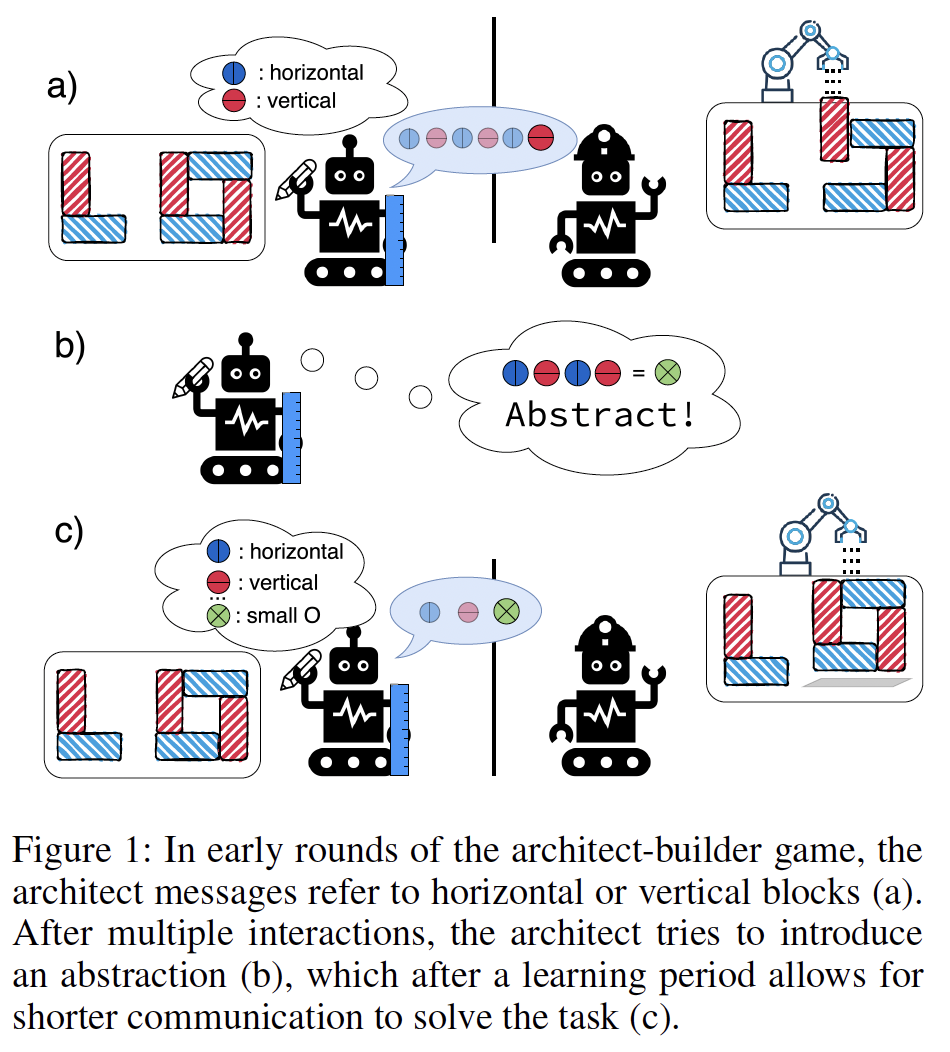
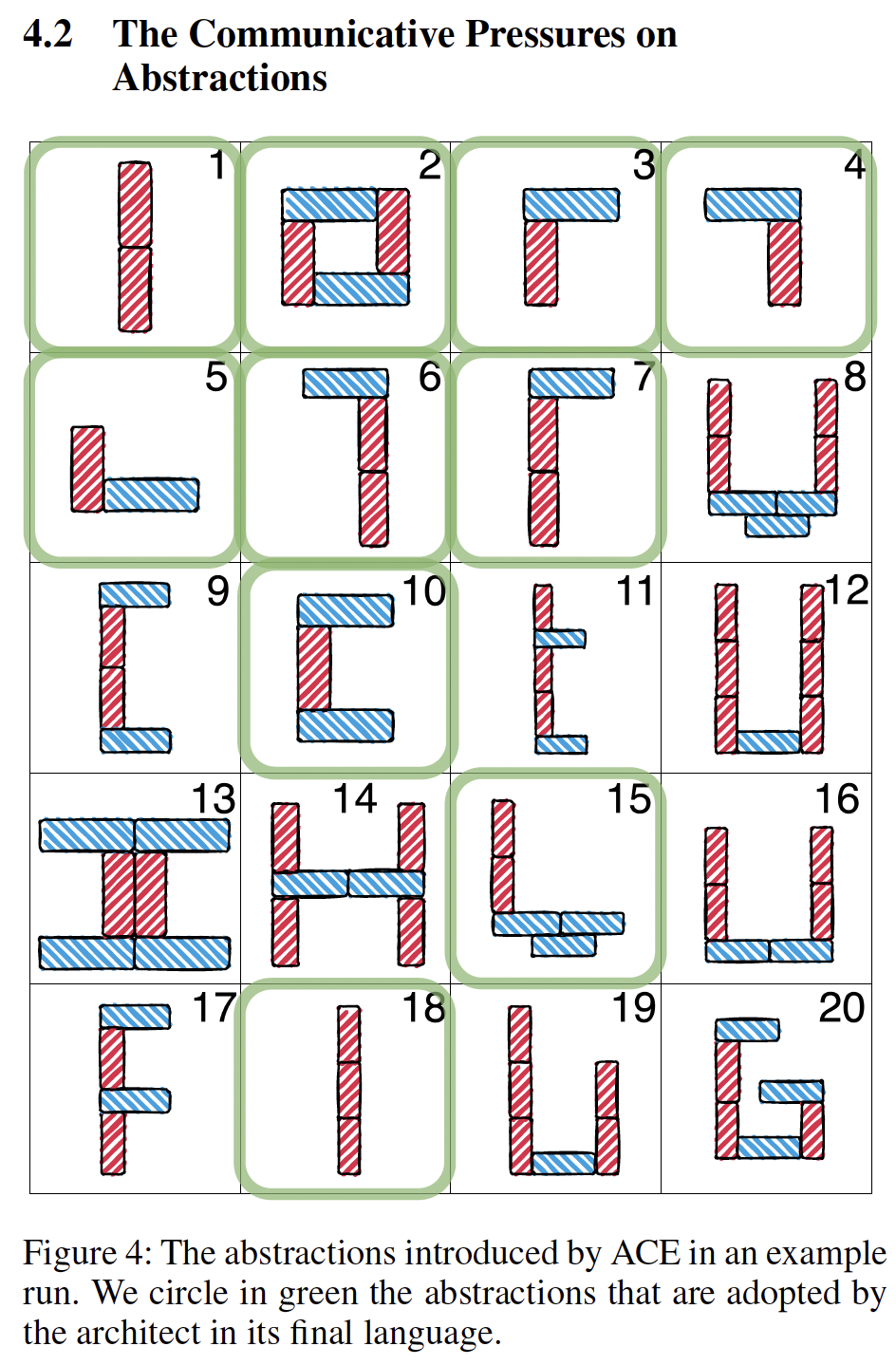
We have demonstrated that ACE exhibits the capability of developing a compact collaborative language, resulting in shorter programs. The size of the language is the consequence of pressures that naturally arise through the need to communicate about a shared task. This is achieved by ACE through a novel combination of EC, library learning and bandits. Our work serves as a bridge between abstraction learning and efficient communication (Kemp and Regier 2012; Gibson et al. 2017; Zaslavsky et al. 2019; Gibson et al. 2019; Denic and Szymanik 2024).
Lines of inquiry this paper opens 14
Research framings built by reading the notes related to this paper — the questions it feeds into.
Can AI systems genuinely understand social norms and relationships? When and why do multi-agent systems outperform single-agent models?- How do cognitive stimulation and process losses interact in group AI systems?
- How do learned teamwork strategies compare to hand-coded coordination protocols?
- How did individual agents shift toward collective swarm behavior?
- What role does exploration-exploitation balance play in abstraction formation?
- What makes composable abstractions emerge under performance pressure in agent systems?
- How does compiling natural language goals into executable code enable objective evolution?
- Why do AI agent societies fail to develop shared behaviors despite interaction?
- Can evolved agent languages be transmitted to new agents that did not create them?