Transcendence: Generative Models Can Outperform The Experts That Train Them
Generative models (GMs) are typically trained to mimic human behavior. These humans may be skilled in their various human objectives: answering a question, creating art, singing a song. The model has only one objective: minimizing the cross-entropy loss with respect to the output distribution, thereby adjusting it to match the distribution of human labels2. Therefore, one might assume the model can, at best, match the performance of an expert on their human objectives. Is it possible for these models to surpass—to transcend—their expert sources in some domains?
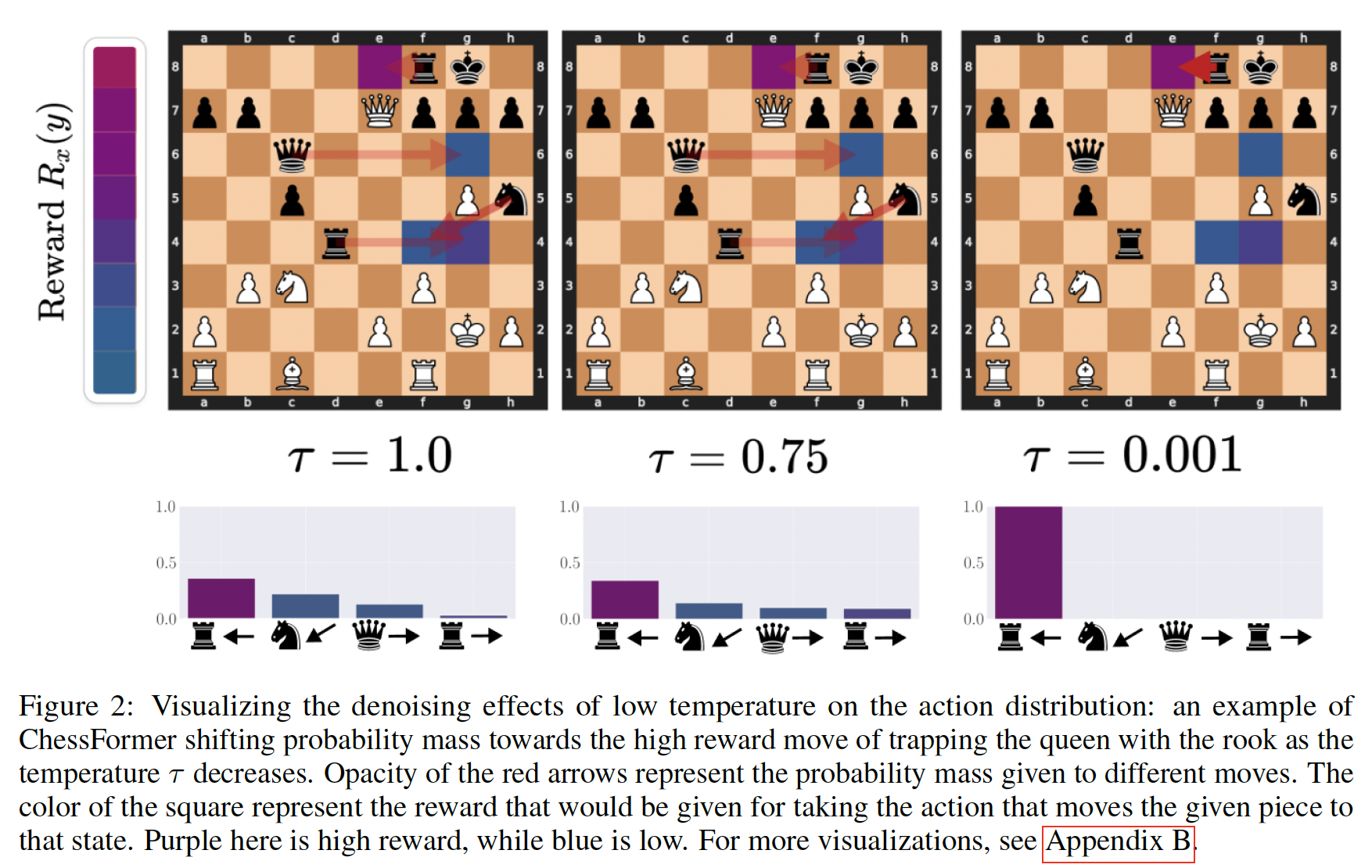
To test for transcendence, we limit the maximal rating of the human players in the dataset below a specified score. We find that ChessFormer 1000 and ChessFormer 1300 (the latter number being the maximum rating seen during training) achieve significant levels of transcendence, surpassing the maximal rating seen in the dataset. Our focus is this capacity of a GM to transcend its expert sources by broadly outperforming any one expert. The key to our findings is the observation that GMs implicitly perform majority voting over the human experts. As these models are trained on a collection of many experts with diverse capacities, predilections, and biases, this majority vote oftentimes outperforms any individual expert, a phenomena that is known as “wisdom of the crowd”.
Our objective is to formalize the notion of transcendence and focus narrowly on this source of improvement over the experts: the removal of diverse human biases and errors. We prove that this form of denoising is enabled by low-temperature sampling, which implicitly induces a majority vote. This draws a subtle but deep connection from our new setting to a rich prior literature on model ensembling [1, 6, 19], enabling several key results. We precisely characterize the conditions under which transcendence is possible, and give a rigorous theoretical framework for enabling future study into the phenomenon. To test the predictive power of our theory, we then empirically demonstrate these effects. Digging deeper into the effects of majority voting, we show that its advantage is primarily due to performing much better on a small subset of states—that is, under conditions that are likely key to determining the outcome of the game. We also find that diversity in the data is a necessary condition for practically effective majority voting, confirming our theoretical findings.
Lines of inquiry this paper opens 24
Research framings built by reading the notes related to this paper — the questions it feeds into.
What systematic biases affect LLM-based evaluation systems?- How does same-author bias interact with the four adversarial judge biases already documented?
- Does ensembling smaller judges reduce bias more effectively than single large judges?
- Can diverse expert demonstrations exceed the knowledge of any single expert?
- What conditions make training diversity better than individual expert quality?
- How does mutual shaping through diverse training compare to population-level diversity effects?
- Does disjoint family diversity actually cancel model-specific bias in evaluation?
- How do experts select which other experts to trust?
- How much noise comes from rater idiosyncrasy versus selection bias?
- Why does low temperature sampling extract consensus from diverse training data?
- When do aggregated imperfect demonstrations fail to outperform the best expert?
- How does majority voting fail when reasoning samples lack genuine diversity?
- Why do self-consistency methods fail where pretraining bias is strongest?
- What signals detect when consensus training is silently degrading performance?
- What happens when majority voting converges to a single answer?
- How do ensemble methods reduce bias in automated evaluation?