Textgrad: Automatic “Differentiation” via Text
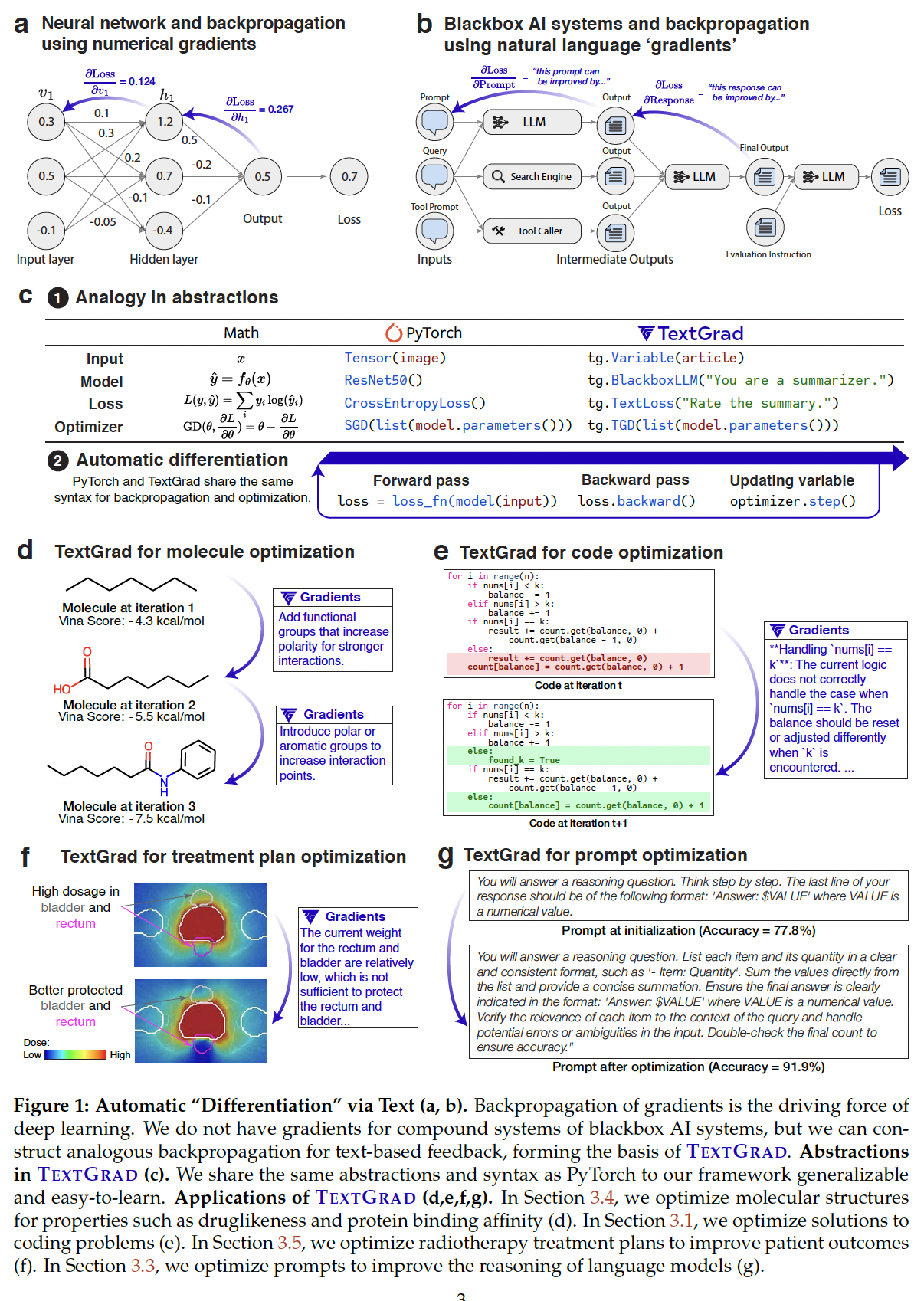
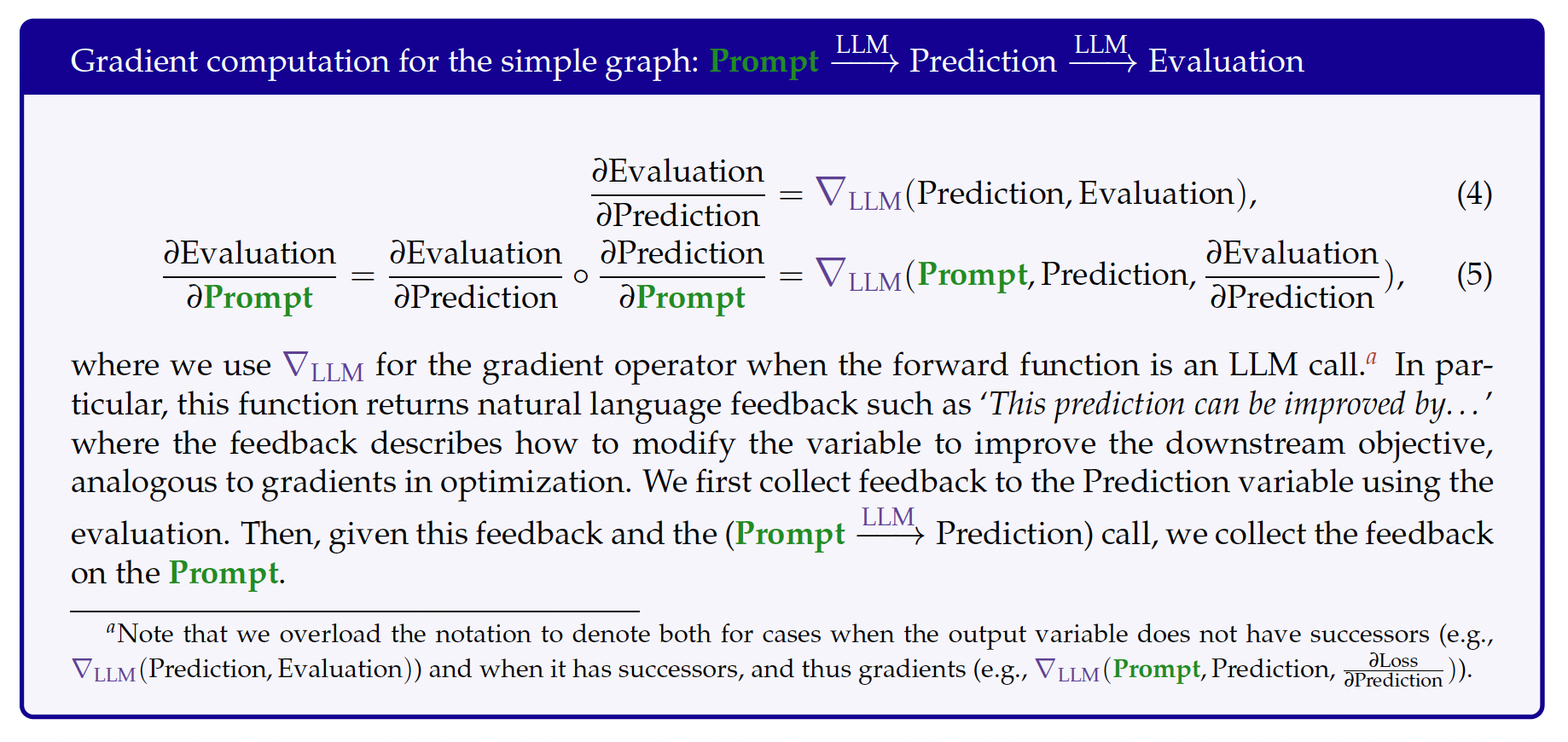
AI is undergoing a paradigm shift, with breakthroughs achieved by systems orchestrating multiple large language models (LLMs) and other complex components. As a result, developing principled and automated optimization methods for compound AI systems is one of the most important new challenges. Neural networks faced a similar challenge in its early days until backpropagation and automatic differentiation transformed the field by making optimization turn-key. Inspired by this, we introduce TEXTGRAD, a powerful framework performing automatic “differentiation” via text. TEXTGRAD backpropagates textual feedback provided by LLMs to improve individual components of a compound AI system. In our framework, LLMs provide rich, general, natural language suggestions to optimize variables in computation graphs, ranging from code snippets to molecular structures. TEXTGRAD follows PyTorch’s syntax and abstraction and is flexible and easy-to-use. It works out-of-the-box for a variety of tasks, where the users only provide the objective function without tuning components or prompts of the framework. We showcase TEXTGRAD’s effectiveness and generality across a diverse range of applications, from question answering and molecule optimization to radiotherapy treatment planning.
Introduction. There is an emerging paradigm shift in how AI systems are built, owing to the breakthroughs of Large Language Models (LLMs) [1–6]. The new generation of AI applications are increasingly compound systems involving multiple sophisticated components, where each component could be an LLM-based agent, a tool such as a simulator, or web search. For instance, a system of LLMs communicating with symbolic solvers can solve olympiad-level math problems [7]; a system of LLMs using search engines and code interpreter tools performs comparably to human competitive programmers [8] and are solving real-world GitHub issues [9]. However, many of these breakthroughs came from systems that are hand-crafted by experts in the domain of application and are tweaked through heuristics. Therefore, developing principled and automated ways to optimize AI systems is one of the most crucial challenges for building compound systems with LLMs, and is necessary for unlocking the power of AI [10–12].
Discussion / Conclusion. TextGrad is built on three key principles: i) It is a general and performant framework that is not handcrafted for a specific application domain, ii) It is easy-to-use, mirroring PyTorch abstractions thus allowing knowledge transfer, iii) It is fully open-source. Through TEXTGRAD, we obtained state-of-the-art results in code optimization and PhD-level question answering, optimized prompts, and provided proof-of-concept results in scientific applications such as developing molecules and optimizing treatment plans. While we took a first step, there are various limitations that motivate future work to realize the potential of automatic differentiation frameworks powered by LLMs. First, while we demonstrated the potential of backpropagating text feedback, there are many applications our framework can be extended to. We hope TEXTGRAD can be used to accelerate iterative processes in scientific discovery and increase the productivity of engineering efforts.