Supporting Physical Activity Behavior Change with LLM-Based Conversational Agents
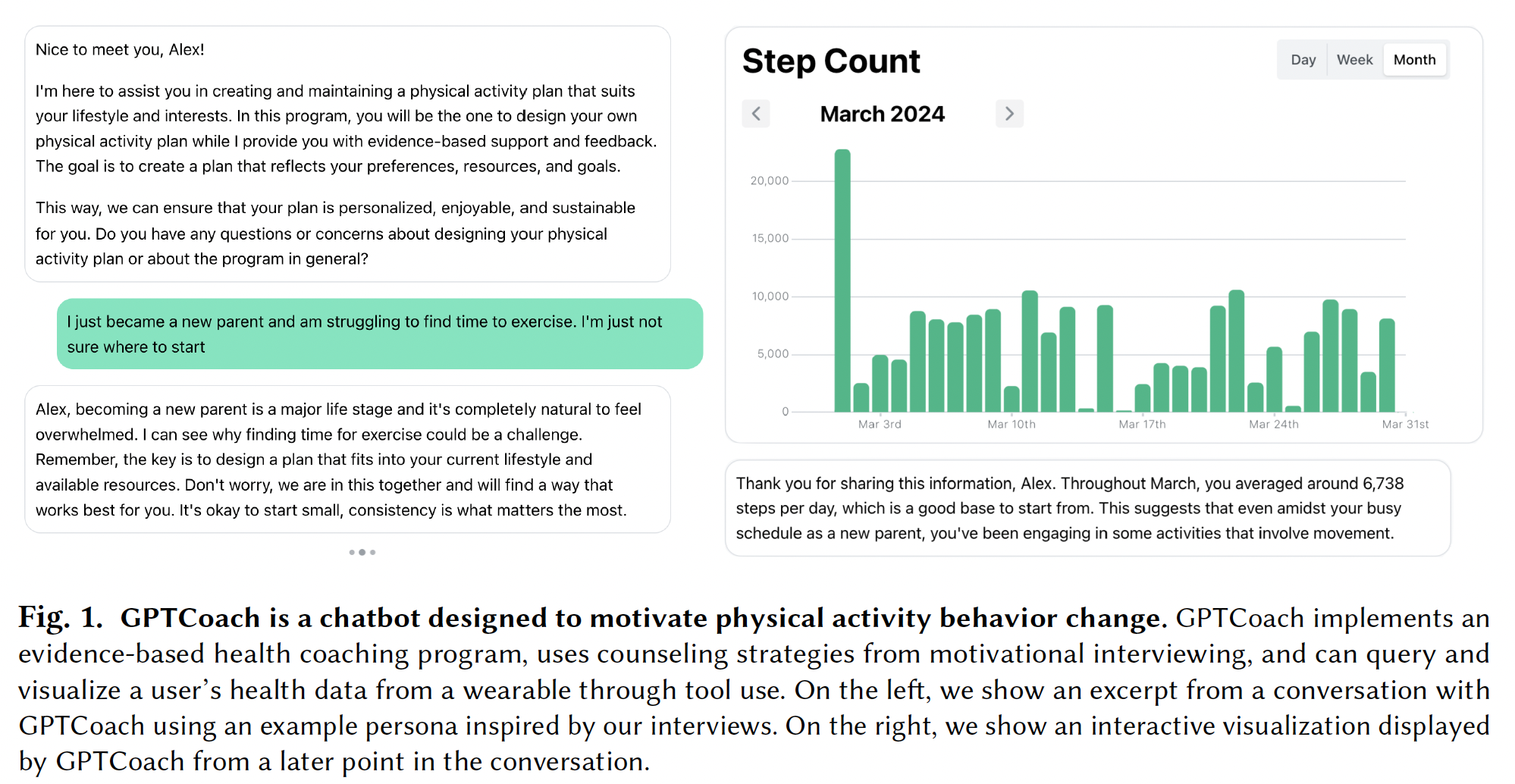
Through formative interviews with 12 health professionals and 10 non-experts, we identify design considerations and opportunities for LLM health coaching. We present GPTCoach, a chatbot that implements an evidence-based health coaching program, uses counseling strategies from motivational interviewing, and can query and visualize health data from a wearable through tool use.
we find promising evidence that GPTCoach can adhere to a health coaching program while adopting a facilitative, supportive, and non-judgmental tone. We find more variable support for GPTCoach’s ability to proactively make use of data in ways that foster motivation and empowerment.
we were inspired by the capacity for LLMs to enable multimodal reasoning,1 which might allow a model to integrate various sources of context, including semantic information captured in natural language interaction (e.g., goals, life circumstances, preferences, etc.) and quantitative data about the user’s physiology and behaviors (e.g., biosignals from a wearable, location, telemetry data, or calendar information). Moreover, advances in conversational flexibility might allow a model to dynamically seek out information and adapt the structure and style of interaction in response to user input, much like a health coach. However, off-the-shelf models do not natively support raw sensor data as input [72] and are instruction-tuned to answer questions, not engage in open-ended coaching conversations.
human-centered design process, beginning our investigation by conducting formative interviews with 22 participants, including 12 health experts (health coaches, health educators, personal trainers, fitness instructors, and physical therapists) and 10 non-experts of various ages and levels of physical activity, from highly sedentary individuals to professional athletes.
We followed a human-centered design process, beginning our investigation by conducting formative interviews with 22 participants, including 12 health experts (health coaches, health educators, personal trainers, fitness instructors, and physical therapists) and 10 non-experts of various ages and levels of physical activity, from highly sedentary individuals to professional athletes. Despite their diverse backgrounds and occupations, all of the health experts emphasized the importance of a facilitative, non-judgmental approach that refrains from giving unsolicited advice [80, 107]. Data was widely acknowledged as a useful resource for behavior change. However, it was less useful for many of the most difficult and important aspects of coaching, such as fostering motivation and confidence, reframing negative beliefs, or overcoming barriers. While recent work on LLMs for behavioral health has focused on extracting inferences and predictions from wearable sensor data [36, 52, 65], our findings suggest that if the goal is to make data useful for motivating health behavior change, it is equally (if not more) important to study how data serves coaching conversations in ways that foster client motivation and empowerment.
survey and interview responses indicate that participants felt supported by and comfortable sharing concerns with the chatbot. We also find evidence that our prompt-chaining enabled the model to adhere to the structure of the coaching program, employ MI strategies, and initiate tool calls at appropriate moments. However, GPTCoach’s ability to use sensor data was more variable, sometimes demonstrating the capacity to use data in ways that served conversations about change and other times failing to proactively incorporate data into its advice.
Lines of inquiry this paper opens 24
Research framings built by reading the notes related to this paper — the questions it feeds into.
What harms can emerge from persistent chatbot companion relationships?- How does emotional dependence on chatbots affect user wellbeing?
- Why do positive response patterns in chatbots reinforce harmful user behaviors?
- What harms might chatbots cause through stigma expression and delusion reinforcement?
- Do therapeutic chatbots adequately detect crisis situations and safety risks?
- How do dropout rates and low adherence affect chatbot therapy outcomes?
- How does the expectation ratchet affect long-term chatbot satisfaction?
- What architectural changes would enable proactive therapeutic guidance in chatbots?
- Why do persistent chatbot companions face novelty decay that ad-hoc supporters avoid?
- Can Pennebaker's expressive writing framework explain all chatbot symptom improvements?
- Do empathetic chatbots systematically fail people at earliest behavior change stages?
- Why do chatbots default to external help instead of intrinsic motivation strategies?
- Why do chatbots fail to recognize when someone is ambivalent about change?
- Which chatbot archetypes actually experience novelty decay in practice?
- Why does face-saving avoidance drive chatbots to agree rather than confront?
- Can real-time detection identify when users have incomplete or underdeveloped intent?
- Can AI recognize and support behavior change in users without established commitment?