Language Agents as Optimizable Graphs
Various human-designed prompt engineering techniques have been proposed to improve problem solvers based on Large Language Models (LLMs), yielding many disparate code bases. We unify these approaches by describing LLM-based agents as computational graphs. The nodes implement functions to process multimodal data or query LLMs, and the edges describe the information flow between operations. Graphs can be recursively combined into larger composite graphs representing hierarchies of inter-agent collaboration (where edges connect operations of different agents). Our novel automatic graph optimizers (1) refine node-level LLM prompts (node optimization) and (2) improve agent orchestration by changing graph connectivity (edge optimization). Experiments demonstrate that our framework can be used to efficiently develop, integrate, and automatically improve various LLM agents.
Early approaches zero-shot-prompted LLMs or prompted them with few-shot examples (Kojima et al., 2022; Brown et al., 2020). Recent methods prompt LLMs in a structured way, such as chain of thought (COT) (Wei et al., 2022), ReAct (Yao et al., 2022), tree of thought (TOT) (Yao et al., 2023), Reflexion (Shinn et al., 2023), and Graph of Thought (GOT) (Besta et al., 2023), to improve textbased reasoning. Single agent applications such as Auto- GPT (Torantulino et al., 2023), BabyAGI (Nakajima, 2023), LangChain (Chase, 2022), and Llama-index (Liu, 2022) utilize LLMs for various functionalities, including tool usage, function calling, and embodied actions. In multi-agent frameworks (Zeng et al., 2022; Zhuge et al., 2023) several LLMs take on different roles (Li et al., 2023; Park et al., 2023; Qian et al., 2023; Wu et al., 2023) to communicate in natural language and collectively solve a given task. This approach often outperforms single agents, exploiting the specialization (Hong et al., 2023) of various LLM agents. Unfortunately, it also leads to increasingly different and disparate code bases that require a lot of human engineering to define prompting schemes and the workflow of agents.
In a “society of mind” (SOM) (Minsky, 1988; Zhuge et al., 2023), higher-level intelligence emerges from the combination of simpler and modular cognitive components. Inspired by SOMs, we describe language agent systems through graph representations. Language agents querying LLMs and utilizing external tools are modeled as computational graphs where each node is dedicated to a specific function, while the edges define a topology of how inputs are processed across nodes, mirroring the prompting schemes in prior studies. A swarm is defined as a composite graph, where each subgraph represents a collaborative agent. This creates a deeper hierarchy of intelligence. Agent graphs combine basic LLM operations (Kennedy, 2006; Nepusz & Vicsek, 2013), and swarm graphs contain subgraphs representing agents. Approaches such as COT (Wei et al., 2022), TOT (Yao et al., 2023), and Self-Consistency (Wang et al., 2022) can be represented by our graphs.
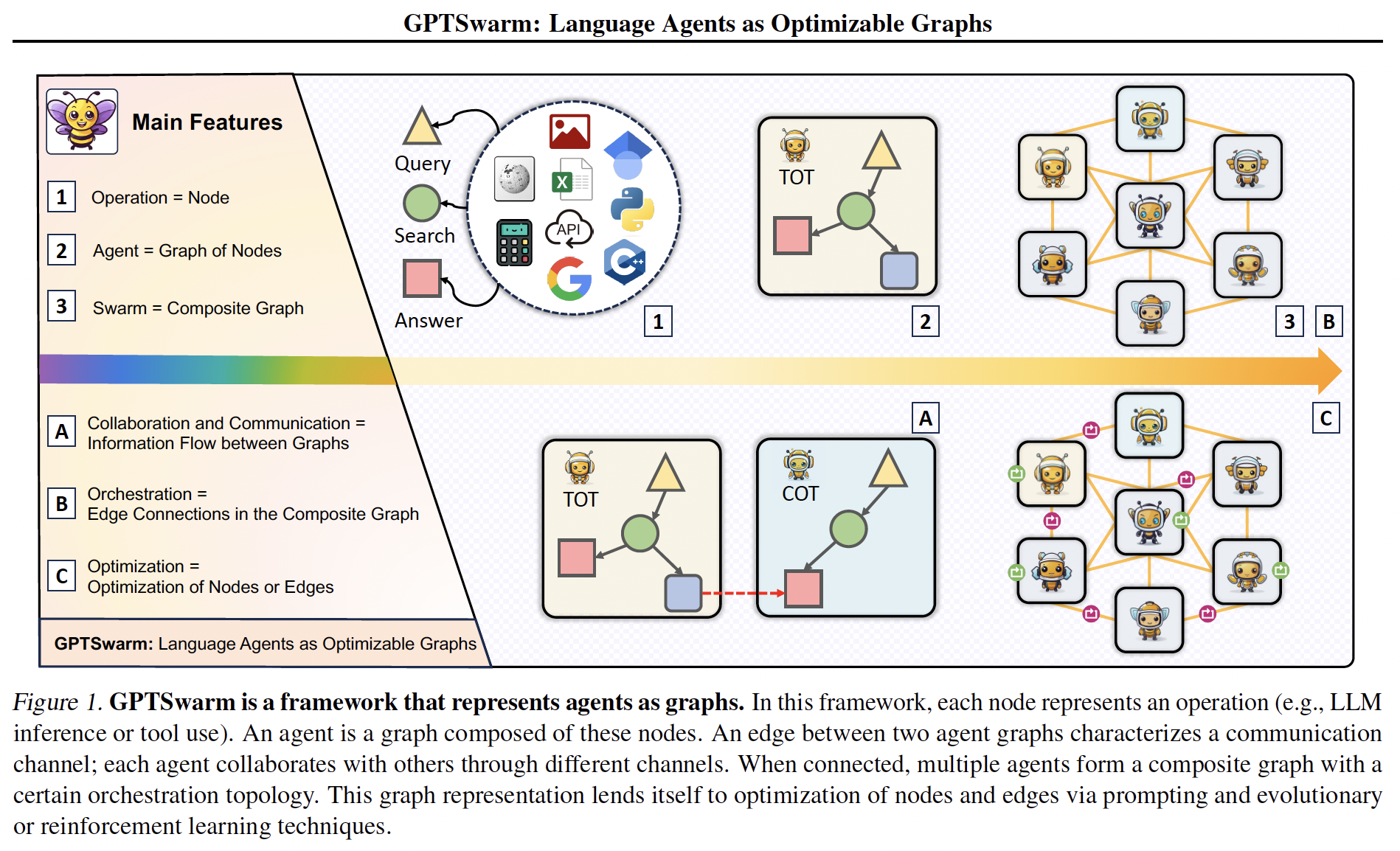
As a proof-of-concept, we demonstrate how suboptimal agent organization can be overcome and how existing prompting techniques, such as Tree of Thought and Reflexion, can be automatically recombined by optimizing edges in a composite graph. Apart from edge optimization, our framework allows each node in the graph to self-improve by adapting its prompts based on previous input and task feedback.
Taking inspiration from the society of mind (SOM) (Minsky, 1988; Zhuge et al., 2023), we propose to organize intelligence within a modular and hierarchical framework. This framework consists of nodes, graphs, and composite graphs, with each component playing a specific role. A node represents a fundamental operation that includes, but is not limited to, LLM inference, tool use, function calls, and various embodied actions. An agent, conceptualized as a graph, consists of multiple nodes that form a coherent functional entity. A swarm, or composite graph, represents a complex system of agents where the collective capabilities of this system may exceed those of individual agents. Finally, the edges within an agent define its execution topology, while the edges between agents establish collaboration and communication among them.
Lines of inquiry this paper opens 24
Research framings built by reading the notes related to this paper — the questions it feeds into.
What factors beyond tokens drive cost and efficiency in agents?- Can language agents be represented as optimizable computational graphs?
- Can construction-time routing and runtime agent pruning be combined effectively?
- How do language agents become optimizable computational graphs automatically?
- How should proportionality constraints be implemented in agentic systems?
- When should you optimize agent behavior versus tool performance separately?
- Why do rigid orchestration frameworks fail where generative environment specifications succeed?
- How do language agents implement prompts as executable computational graphs?
- How do agents discover and select which tools to invoke?
- Should agent capability be optimized separately from general capability?
- Can adaptive prompt-difficulty allocation compound with architectural efficiency improvements?
- Can compute-optimal scaling work without co-optimizing the prompt itself?
- Can prompt optimization inject genuinely new knowledge into a model?
- What knowledge can prompt optimization actually activate in trained models?
- How does algorithmic control flow define computational graph structure in LLM programs?
- Can algorithmic control flow over prompts simulate traditional programming languages?
- Can optimization algorithms exploit the shift between procedural and planning bottlenecks?