Premise Order Matters in Reasoning with Large Language Models
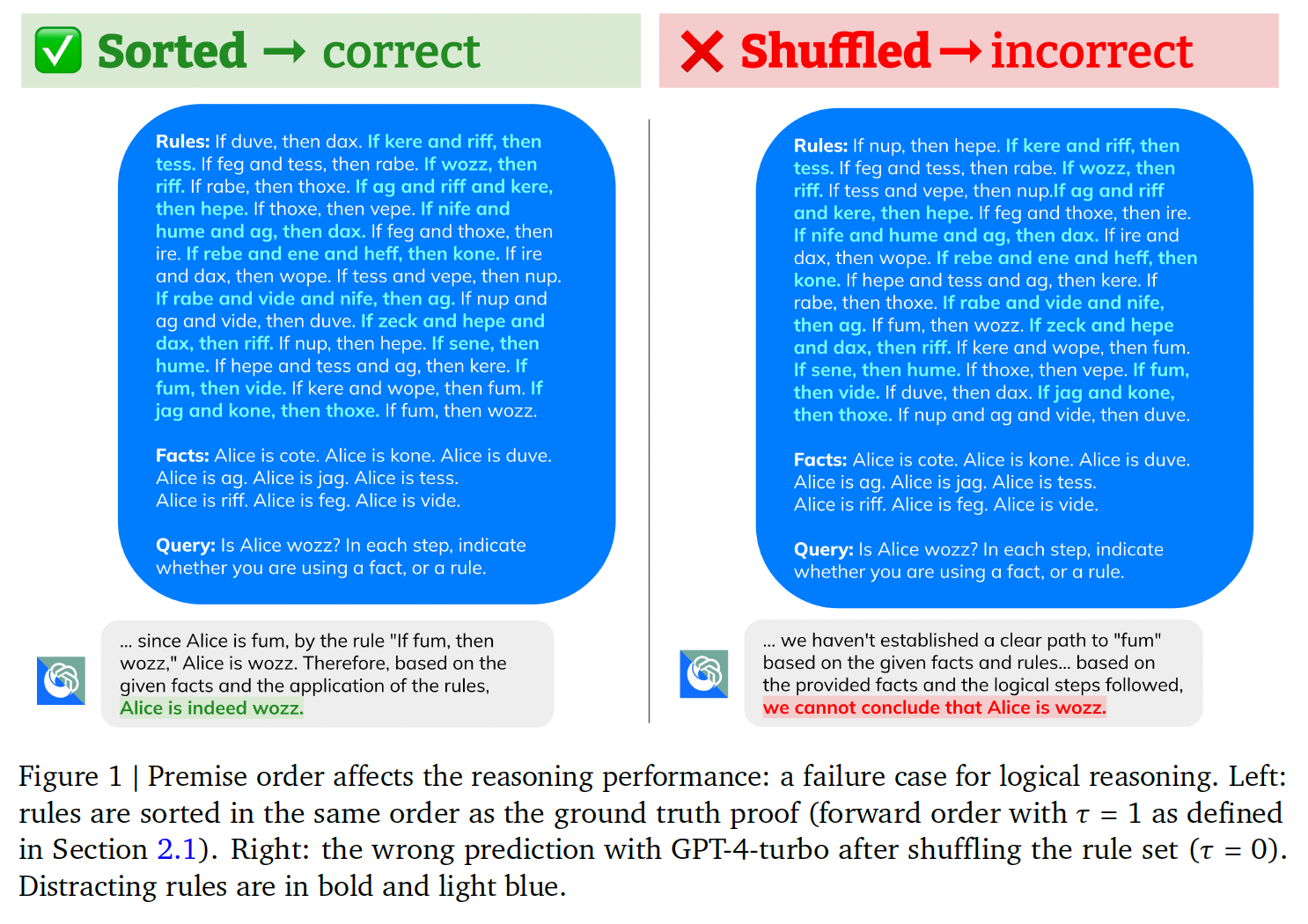
Large language models (LLMs) have accomplished remarkable reasoning performance in various domains. However, in the domain of reasoning tasks, we discover a frailty: LLMs are surprisingly brittle to the ordering of the premises, despite the fact that such ordering does not alter the underlying task. In particular, we observe that LLMs achieve the best performance when the premise order aligns with the context required in intermediate reasoning steps. For example, in deductive reasoning tasks, presenting the premises in the same order as the ground truth proof in the prompt (as opposed to random ordering) drastically increases the model’s accuracy. We first examine the effect of premise ordering on deductive reasoning on a variety of LLMs, and our evaluation shows that permuting the premise order can cause a performance drop of over 30%. In addition, we release the benchmark R-GSM, based on GSM8K, to examine the ordering effect for mathematical problem-solving, and we again observe a significant drop in accuracy, relative to the original GSM8K benchmark.
Introduction. Large language models (LLMs) have demonstrated impressive performance across a variety of reasoning tasks (Austin et al., 2021; Chen et al., 2021; Cobbe et al., 2021; Hendrycks et al., 2021; Wei et al., 2022). In particular, recent state-of-the-art LLMs have reached or even surpassed human performance on multiple reasoning benchmarks, including STEM problem-solving and code generation (Bubeck et al., 2023; Gemini, 2023; Li et al., 2022). However, recent works show that LLMs exhibit failure modes that align with human-like cognitive bias (Berglund et al., 2023; Hagendorff et al., 2023; Jones and Steinhardt, 2022; McCoy et al., 2023; Shi et al., 2023). For example, Berglund et al. (2023) revealed the Reversal Curse; i.e., LLMs trained on “A is B” tend to fail to infer that “B is A.” Distractibility is another failure mode (Jones and Steinhardt, 2022; Shi et al., 2023), where the LLM performance drastically decreases when irrelevant context is included in the task description. In this work, we investigate the effect that premise order has on LLM reasoning.
Discussion / Conclusion. In this work, we show that the premise order significantly affects LLMs’ performance on reasoning tasks, even when the premise order does not change the underlying task itself. Our comprehensive evaluation demonstrates that LLM tendencies resemble human preference w.r.t. premise order, i.e., LLMs achieve the best performance when the premise order follows the intermediate reasoning steps to solve the problem. Conversely, LLMs face difficulties when the reasoning problem requires the model to read the problem description back-and-forth, resulting in a performance drop of over 30%. We further extend the study to mathematical reasoning and present the R-GSM benchmark, and again experimentally confirm the ordering effect. While humans also have a preference of premise orders for reasoning problems, LLMs are much more susceptible to such ordering effects. We can attempt to ascribe the premise order effect to several candidate factors, such as the auto-regressive model design, training objectives, and training data mixture.