Think-in-Memory: Recalling and Post-thinking Enable LLMs with Long-Term Memory
Memory-augmented Large Language Models (LLMs) have demonstrated remarkable performance in long-term human-machine interactions, which basically relies on iterative recalling and reasoning of history to generate high-quality responses. However, such repeated recall-reason steps easily produce biased thoughts, i.e., inconsistent reasoning results when recalling the same history for different questions. On the contrary, humans can keep thoughts in the memory and recall them without repeated reasoning. Motivated by this human capability, we propose a novel memory mechanism called TiM (Think-in-Memory) that enables LLMs to maintain an evolved memory for storing historical thoughts along the conversation stream. The TiM framework consists of two crucial stages: (1) before generating a response, a LLM agent recalls relevant thoughts from memory, and (2) after generating a response, the LLM agent post-thinks and incorporates both historical and new thoughts to update the memory. Thus, TiM can eliminate the issue of repeated reasoning by saving the post-thinking thoughts as the history. Besides, we formulate the basic principles to organize the thoughts in memory based on the well-established operations, (i.e., insert, forget, and merge operations), allowing for dynamic updates and evolution of the thoughts.
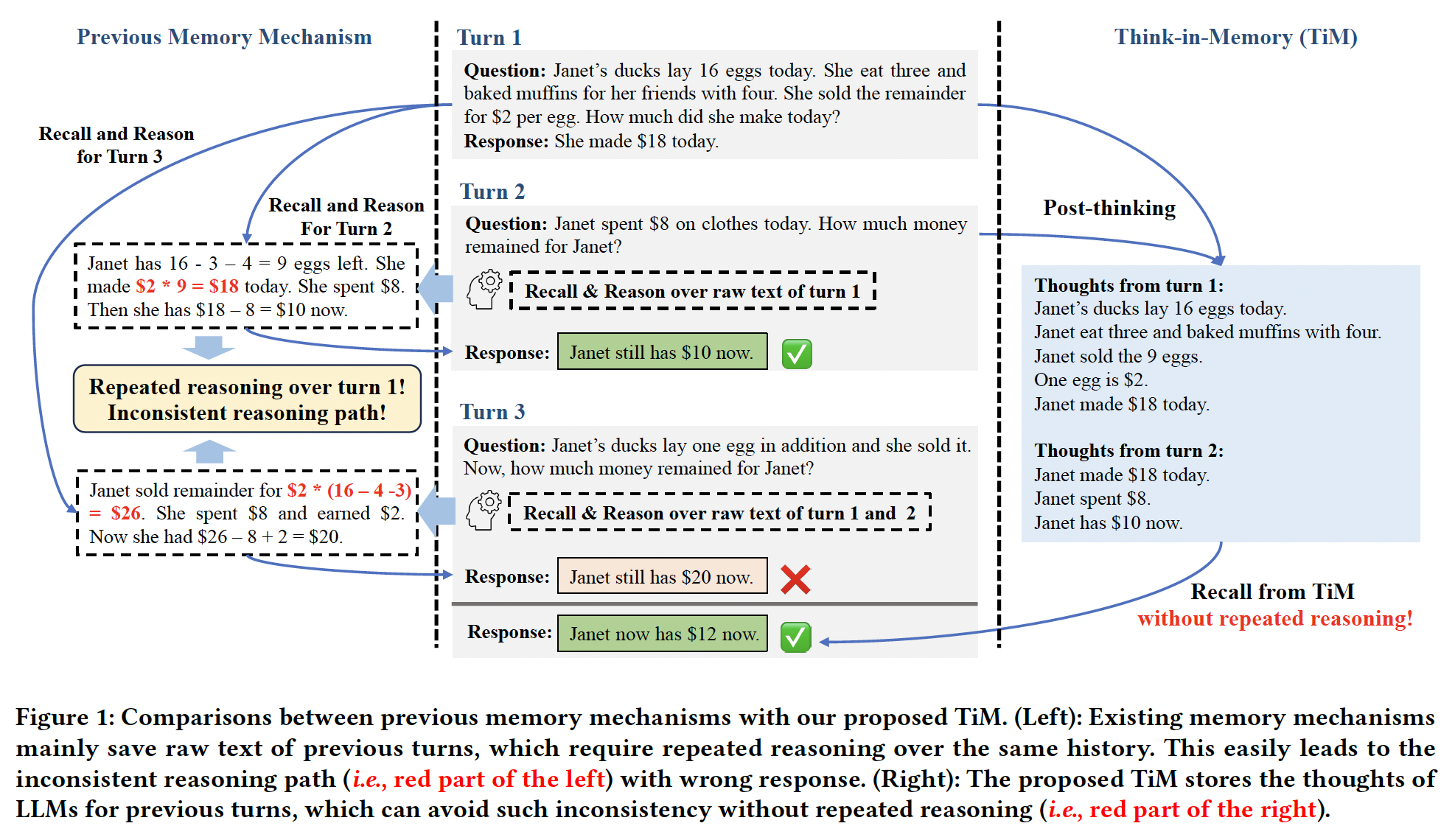
Unfortunately, this paradigm is prone to encountering several issues and potentially causes a performance bottleneck in real-world applications. The main issues are shown in follows:
• Inconsistent reasoning paths. Prior studies [13, 14] has shown that LLMs easily generate diverse reasoning paths for the same query. As shown in Figure 1 (Left), LLMs give a wrong response due to inconsistent reasoning over the context.
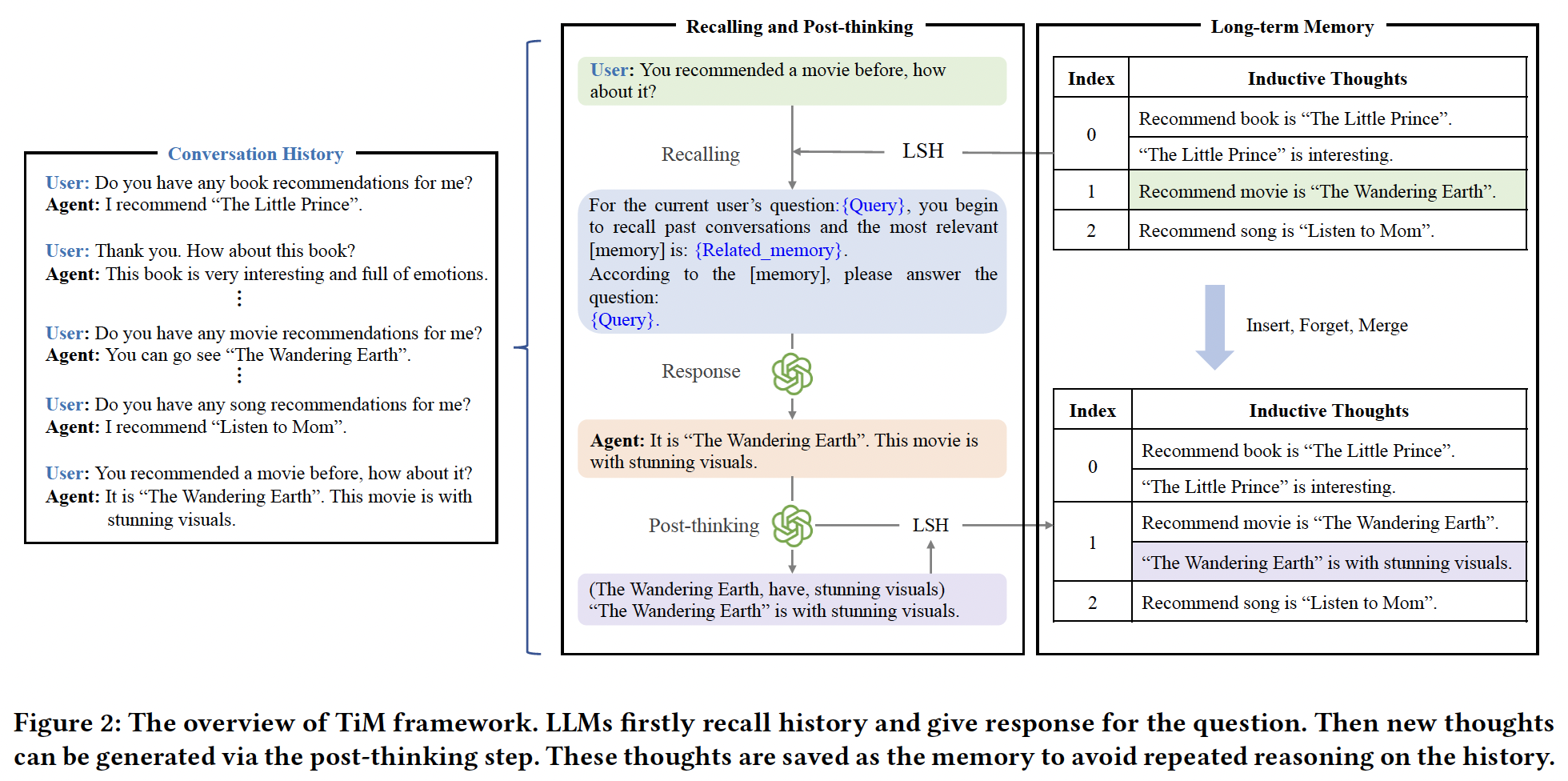
• Unsatisfying retrieval cost. To retrieve relevant history, previous memory mechanisms need to calculate pairwise similarity between the question and each historical conversation, which is time-consuming for long-term dialogue.
Lines of inquiry this paper opens 24
Research framings built by reading the notes related to this paper — the questions it feeds into.
What memory architectures best support persistent learning across sessions?- Why does storing past judgments in memory make current evaluations worse?
- Can compressive memory track what matters most across 35 conversation sessions?
- Why does persistent memory alone fail to create genuine position-holding in models?
- Why do LLMs struggle to update beliefs across multiple conversation turns?
- What is the relationship between topic following and topic revisitation in conversation?
- What makes pronouns and demonstratives problematic in conversational retrieval systems?
- What makes two conversation turns the same thread rather than different threads?
- What causes multi-turn dialogue quality to degrade over time?
- Can conversational memory store precomputed thoughts instead of raw interaction history?
- How does selective history retrieval improve conversational search accuracy?
- What interaction history signals indicate what a participant finds relevant?
- Why does selective conversation history outperform including all prior context?
- How does multi-turn dialogue improve user satisfaction in search interactions?