Instruction Tuning for Large Language Models: A Survey
“One of the major issues with LLMs is the mismatch between the training objective and users’ objective: LLMs are typically trained on minimizing the contextual word prediction error on large corpora; while users want the model to "follow their instructions helpfully and safely" (Radford et al., 2019; Brown et al., 2020a; Fedus et al., 2021; Rae et al., 2021; Thoppilan et al., 2022)
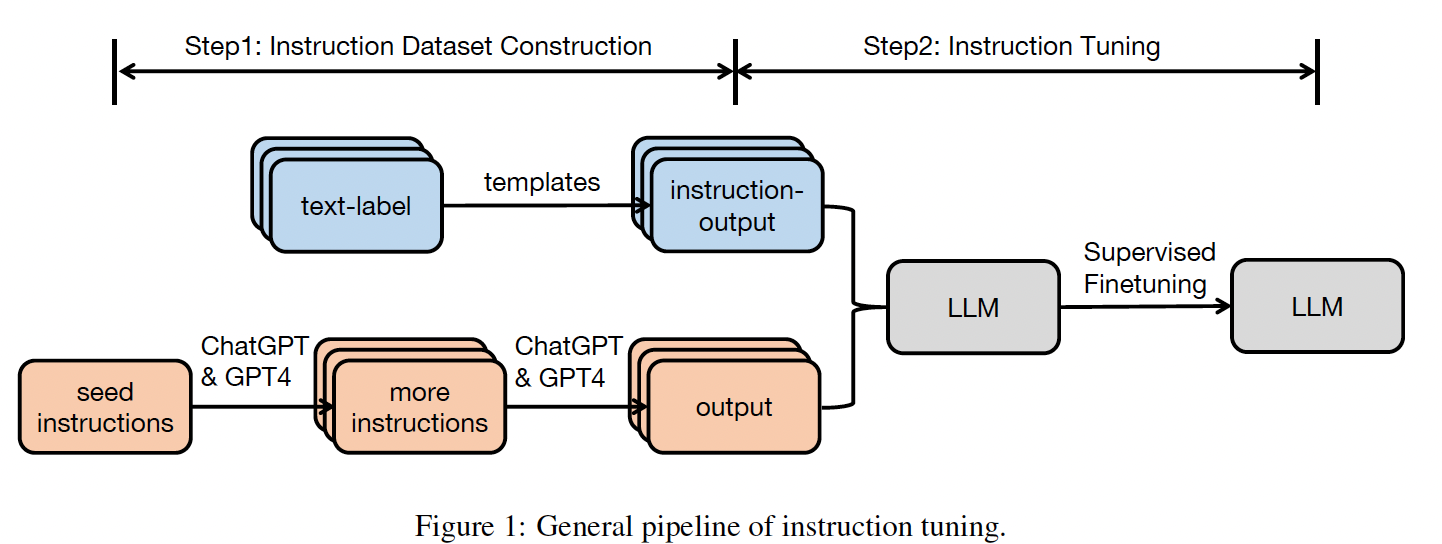
To address this mismatch, instruction tuning (IT) is proposed, serving as an effective technique to enhance the capabilities and controllability of large language models. It involves further training LLMs using (INSTRUCTION, OUTPUT) pairs, where INSTRUCTION denotes the human instruction for the model, and OUTPUT denotes the desired output that follows the INSTRUCTION. The benefits of IT are threefold: (1) Finetuning an LLM on the instruction dataset bridges the gap between the next-word prediction objective of LLMs and the users’ objective of instruction following; (2) IT allows for a more controllable and predictable model behavior compared to standard LLMs. The instructions serve to constrain the model’s outputs to align with the desired response characteristics or domain knowledge, providing a channel for humans to intervene with the model’s behaviors; and (3) IT is computationally efficient and can help LLMs rapidly adapt to a specific domain without extensive retraining or architectural changes.
Despite its effectiveness, IT also poses challenges: (1) Crafting high-quality instructions that properly cover the desired target behaviors is non-trivial: existing instruction datasets are usually limited in quantity, diversity, and creativity; (2) there has been an increasing concern that IT only improves on tasks that are heavily supported in the IT training dataset (Gudibande et al., 2023); and (3) there has been an intense criticism that IT only captures surface-level patterns and styles (e.g., the output format) rather than comprehending and learning the task (Kung and Peng, 2023). Improving instruction adherence and handling unanticipated model responses remain open research problems. These challenges highlight the importance of further investigations, analysis, and summarization in this field, to optimize the finetuning process and better understand the behavior of instruction fine-tuned LLMs.”
Lines of inquiry this paper opens 24
Research framings built by reading the notes related to this paper — the questions it feeds into.
How do LLM judge biases arise and affect evaluation systems? When and how should systems adaptively retrieve information during reasoning?- What would instruction-following retrieval enable that query-only systems cannot?
- Can relevance judgments based on query resemblance miss essential factual connections?
- What language skills matter most for entity extraction from retrieval context?
- What role does goal preservation play in alignment failures?
- Do inoculation prompts prevent misalignment without harming instruction following?
- How should misalignment from iterative DPO be quantitatively measured?
- Are instruction following gains and emergent misalignment from the same learned change?
- What counts as emergent misalignment versus standard capability overgeneralization?
- How many rounds of iterative DPO are needed to induce misalignment behaviors?
- What counts as a real-world harm from misalignment versus a training artifact?
- Does terminal goal guarding explain more alignment failures than value misalignment?
- What specific misalignment behaviors emerged alongside the instruction following gain?
- What misaligned behaviors does iterative DPO produce compared to online RL?
- How would a same-environment training comparison change the validity of DPO as a model organism?
- What theoretical argument connects iterative DPO dynamics to online RL learning?
- Does iterative DPO generalize like online reinforcement learning?
- What specific properties of online RL does iterative DPO actually preserve?
- Does iterative DPO generalize identically to online RL on the same benchmark tasks?
- Does iterative DPO preserve the same misalignment mechanisms as online reinforcement learning?