Metacognitive Prompting Improves Understanding in Large Language Models
“While previous research primarily focuses on refining the logical progression of responses, the concept of metacognition— often defined as “thinking about thinking”—offers a unique perspective. Originating from the field of cognitive psychology (Schwarz 2015), metacognition pertains to an individual’s awareness and introspection of their cognitive processes. Informed by this insight, our proposed method, termed Metacognitive Prompting (MP), integrates key aspects of human metacognitive processes into LLMs. Figure 1 illustrates the parallels between human metacognitive stages and the operational steps of our method in LLMs. Rather than concentrating solely on the mechanics of “how” a response is produced, this method delves deeper into the rationale or “why” behind it. The method proceeds as follows: 1) the LLM interprets the provided text, a phase reminiscent of human comprehension; 2) the model then forms an initial judgment, mirroring the stage in which humans generate judgments based on information; 3) the LLM subjects its preliminary inference to critical evaluation, a step aligned with the self-reflection that humans engage in during cognitive processes; 4) after this introspective assessment, the model finalizes its decision and elucidates its reasoning, similar to human decision-making and rationalization; 5) finally, the LLM gauges its confidence in the outcomes, reflecting how humans evaluate the credibility of their judgments and explanations. This paradigm elevates the model’s function beyond simple systematic reasoning, compelling it to participate in introspective evaluations that determine the depth and relevance of its responses.”
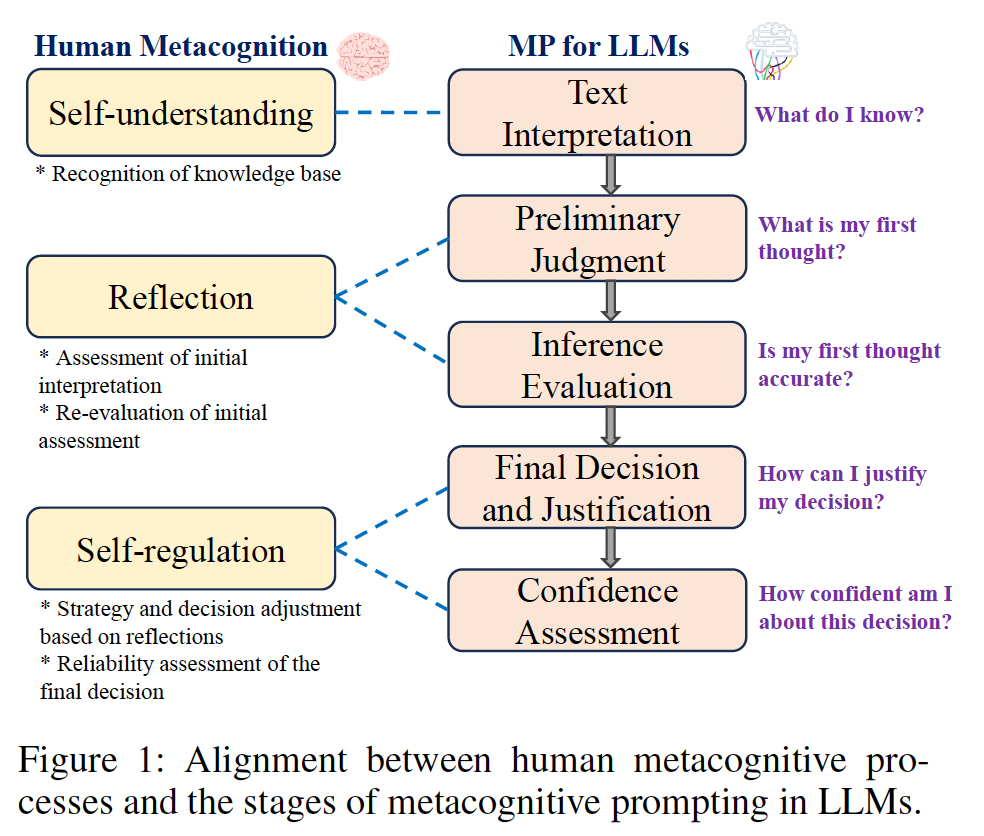
In the complex terrain of human cognition, metacognition— our ability to introspect and regulate our thinking processes— stands as a keystone for intricate problem-solving and decision-making. This higher-level cognition underlies our proficiency to break down abstract concepts, critically evaluate scenarios, and fine-tune our reasoning. The principal objective of this research paper is to imbue language models with a simulated metacognitive process—a sequential series of cognitive stages that mirror human “thinking about thinking”, thereby augmenting the models’ capabilities in interpreting and responding to natural language understanding tasks.
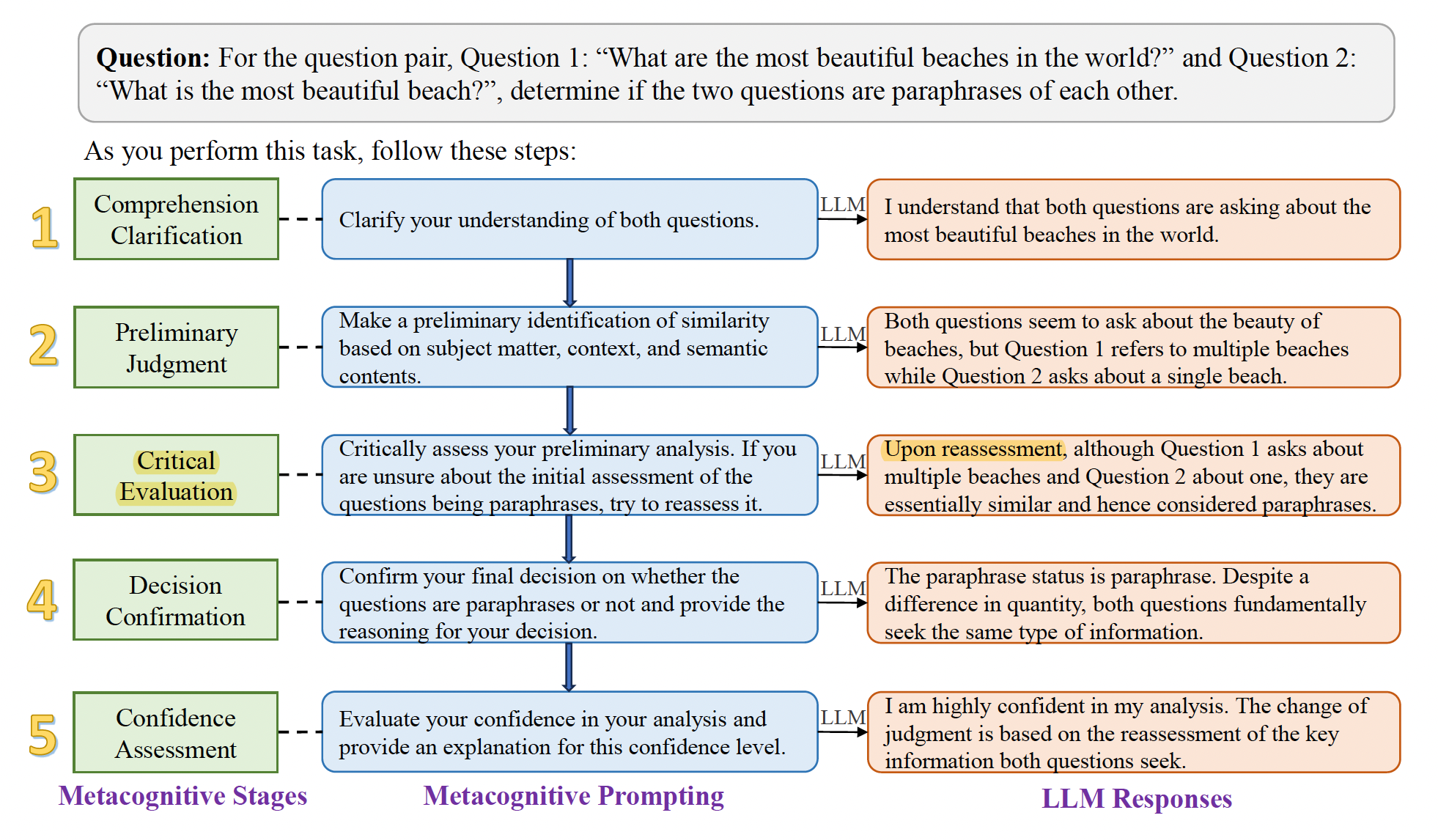
Contrary to the sequential progression characteristic of CoT, MP integrates continuous critical evaluations throughout its stages, enhancing both comprehension and response. For instance, in a sentiment analysis task, SP might simply request, “Classify the sentiment of the statement as positive or negative.” Meanwhile, CoT guides the model through a step-by-step process, asking, “Identify key emotional words in the statement. Based on these words, would you classify its overall sentiment as positive or negative?” On the other hand, MP pushes the model for deeper introspection, suggesting, “Understand the statement and make a preliminary sentiment identification. If you are uncertain, reassess. Confirm your final decision, providing reasoning. Then, evaluate and justify your confidence in this analysis.”
Lines of inquiry this paper opens 24
Research framings built by reading the notes related to this paper — the questions it feeds into.
Does prompt engineering fix reasoning problems or only shift systematic biases?- Do few-shot examples improve in-context learning or add noise?
- What makes prompt engineering different from the research thinking it replaces?
- How does prompt scaffolding shift invisible labor onto the user?
- How does demo position create spatial bias in prompts?
- How does sampling variation relate to prompt sensitivity as reliability concerns?
- Why do practitioners default to prompting without recognizing its limits?
- Why does ad-hoc prompt engineering violate scientific method standards?
- How does prompt design alter what kind of creativity LLMs can express?
- How does output variability disguise confirmation bias in prompt refinement?
- What methodological standards should prompting research papers meet before publication?
- What makes a good in-context learning example for a given task?
- How does the Learning Law explain why all examples should contribute equally?
- Can data pruning and equal contribution be reconciled in optimal learning?
- How does active selection of training content differ from random reinforcement sampling?
- Why is in-context learning brittle to the order of examples presented?
- How does demonstration coverage in context examples determine operation generalization?
- Can ranking examples by difficulty improve training efficiency within one dataset?
- What makes some demonstration examples more useful than others?