Automatically Correcting Large Language Models: Surveying the landscape of diverse self-correction strategies
However, their efficacy is undermined by undesired and inconsistent behaviors, including hallucination, unfaithful reasoning, and toxic content. A promising approach to rectify these flaws is self-correction, where the LLM itself is prompted or guided to fix problems in its own output. Techniques leveraging automated feedback—either produced by the LLM itself or some external system—are of particular interest as they are a promising way to make LLM-based solutions more practical and deployable with minimal human feedback. This paper presents a comprehensive review of this emerging class of techniques. We analyze and taxonomize a wide array of recent work utilizing these strategies, including training-time, generation-time, and post-hoc correction.
A prevailing strategy to rectify these undesired behaviors of LLMs is learning from feedback, mirroring a typical human learning strategy where individuals actively refine their behaviors through a cycle of trial, error, and correction. Humans, when making mistakes, often gather feedback either from others or through self-reflection. Such feedback offers valuable insights into missteps and proposes potential avenues for improvement. With feedback, humans can adapt and modify their behavior accordingly, learning to correct their mistakes over time. Inspired by this natural learning mechanism, extensive research (Huang et al., 2022; Madaan et al., 2023; Gero et al., 2023; Jiang et al., 2023) has been undertaken to improve LLMs through the paradigm of learning from feedback.
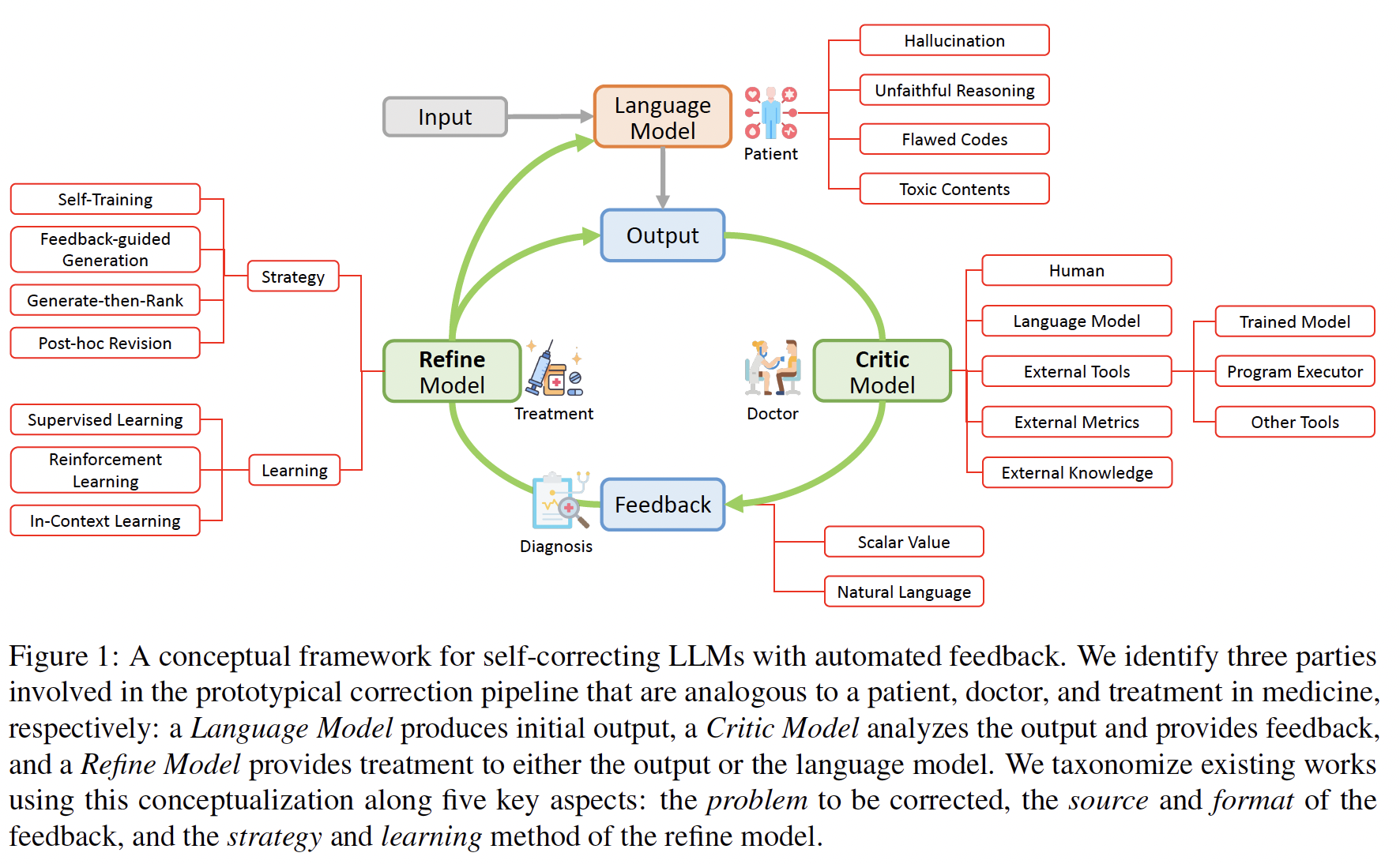
To minimize the need for human intervention, another strategy is self-correcting LLMs with automated feedback, where the model (iteratively) learns from automatically generated feedback signals to understand the consequences of its actions and adapts its behaviors
The source of automated feedback can be multifaceted, spanning from the LLM itself acting as the feedback model (Madaan et al., 2023; Schick et al., 2023), a separately trained feedback model (Yang et al., 2022b; Paul et al., 2023), readily available external tools (Gou et al., 2023; Chen et al., 2023d), to external knowledge sources such as Wikipedia or the internet (Yu et al., 2023; Li et al., 2023b). Different strategies have been proposed to correct LLM with automated feedback, including self-training (Huang et al., 2022; Bai et al., 2022b), generate-then-rank (He et al., 2023; Weng et al., 2023), feedback-guided decoding (Yang et al., 2022a; Xie et al., 2023), iterative post-hoc revision (Zhang et al., 2023a; Jiang et al., 2023), etc. Recently, the incorporation of such strategies has demonstrated their effectiveness across a myriad of tasks, from question answering (Peng et al., 2023) and reasoning (Pan et al., 2023) to code generation (Zhang et al., 2023b) and toxicity detection (Lu et al., 2022).
Lines of inquiry this paper opens 24
Research framings built by reading the notes related to this paper — the questions it feeds into.
Why does self-revision fail to improve reasoning model accuracy?- Does appending a single word at test time unlock model self-correction abilities?
- How does error distribution during training affect a model's ability to self-correct?
- Does chat-mode deference prevent LLMs from actually taking meaningful positions?
- How do human feedback and data distribution shape LLM discourse competence?
- Can proactive critical thinking alone enable models to request clarification effectively?
- Can language systems learn when to ask for clarification instead of choosing one reading?
- Can proactive critical thinking train models to request clarification actively?
- Can LLMs learn to ask clarifying questions instead of guessing?
- What training approach enables models to proactively request clarification?
- Do models naturally learn to ask clarifying questions without explicit supervision?
- Can models learn to ask clarifying questions instead of answering prematurely?