Learning to Relate to Previous Turns in Conversational Search
As in any conversation in natural language, queries in conversational search may involve omissions, references to previous turns, and ambiguities [32]. Thus, a primary challenge for effective conversation search is to determine the underlying information need by understanding context-dependent query turns. Some previous studies [17, 37, 40, 41, 43] exploited a two-stage pipeline, which first trains a query rewriting (QR) model with external data or human reformulated queries, then feeds the rewritten queries into a retriever. However, it is required that sufficient manual annotations are available for model training, which is difficult to obtain in practice [1, 2]. Furthermore, the manually reformulated queries may not be the best search queries because the reformulation is based on human understanding of the query rather than on the search results. We also observe that the rewriting model is usually trained separately from the retriever, making it difficult to optimize the whole system for the final retrieval performance [20, 41]. In particular, the learned rewriting model may not best fit the retriever used in the subsequent step.
Another research direction [15, 24, 30, 44] tries to train a conversational query encoder by leveraging all the previous context information. A common approach uses all the historical queries in the session to expand the current query. Although this expansion leads to improved results, it makes a strong assumption that all the previous queries are related to the current one. In reality, we often observe topic switches within a conversation session, which means the current query may not be related to the previous ones. Fig. 1 illustrates such an example, where we see that only part of the historical queries is relevant to the last query (either by human annotators or by our model). Simply leveraging all the historical queries will inevitably inject irrelevant information into the expanded query and result in sub-optimal queries.
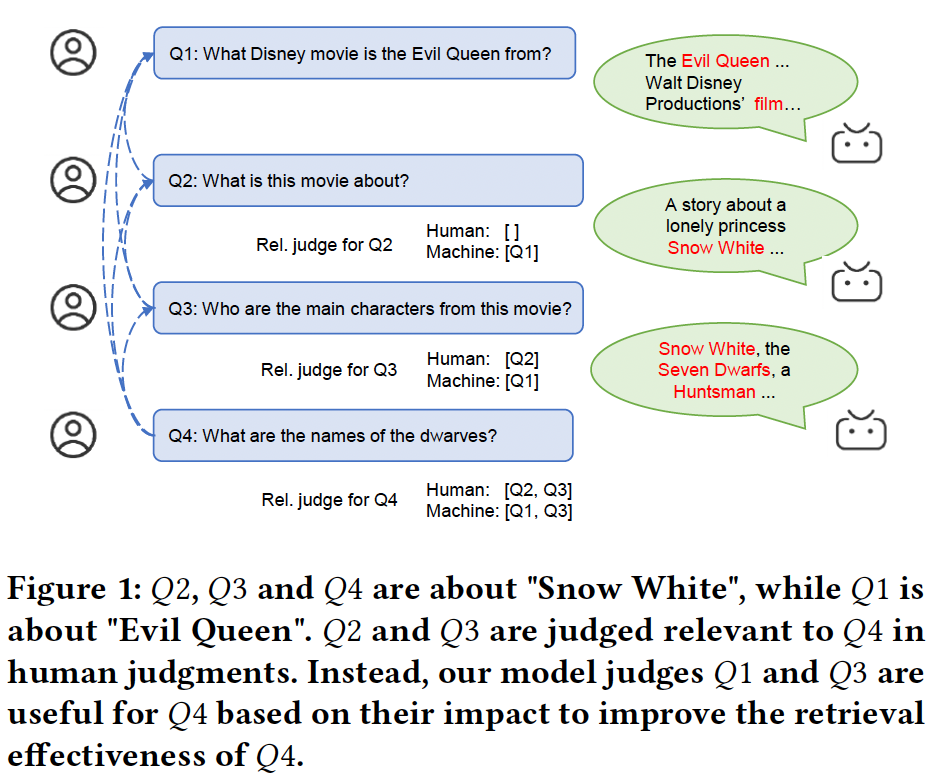
“Conversational search allows a user to interact with a search system in multiple turns. A query is strongly dependent on the conversation context. An effective way to improve retrieval effectiveness is to expand the current query with historical queries. However, not all the previous queries are related to, and useful for expanding the current query.
....
So the crucial question is: how can we select useful information from history context for query expansion/reformulation?
...we investigate how to select useful historical turns to expand the current query in conversational search. The selection is made according to the usefulness of the previous queries, i.e. if the latter can help improve the retrieval effectiveness of the current query. Intuitively, this could help select more useful previous queries for the search task.
- We propose an efficient and effective method to select useful previous queries to expand the current query without human annotations.
(2) We propose a multi-task learning method to jointly optimize the query selection model and the dense retrieval model.
(3) We demonstrate the effectiveness of the proposed method and show its broad applicability in various settings (i.e. with or without training data). In addition, the proposed method can select better previous queries than human annotators.”
Lines of inquiry this paper opens 24
Research framings built by reading the notes related to this paper — the questions it feeds into.
How should agents learn and use user preferences during conversation?- Why do bag-of-mentions models discard conversation order in the first place?
- What interaction history signals indicate what a participant finds relevant?
- How does multi-turn dialogue improve user satisfaction in search interactions?
- Why do conversational queries drift away from what triggered them?
- How do time gaps between conversations change what chatbots should remember?
- Does full conversation history improve or degrade multi-turn retrieval accuracy?
- How does selective history retrieval improve conversational search accuracy?
- What is the relationship between topic following and topic revisitation in conversation?
- Can concept-based search bridge the vocabulary mismatch between conversation and item index?
- What makes pronouns and demonstratives problematic in conversational retrieval systems?
- Why does selective conversation history outperform including all prior context?
- Can compressive memory track what matters most across 35 conversation sessions?
- What causes multi-turn dialogue quality to degrade over time?
- How does raw conversation history differ from distilled memory profiles?
- Why do current AI tools treat location and chat history as sufficient context?
- Why do conversational systems struggle more than static retrieval with ambiguous queries?
- How should temporal metadata indexing differ from semantic indexing?
- How do time-based and entity-based queries differ from semantic similarity retrieval?
- Why do longer queries benefit less from clarification questions?