Logic-LM: Empowering Large Language Models with Symbolic Solvers for Faithful Logical Reasoning
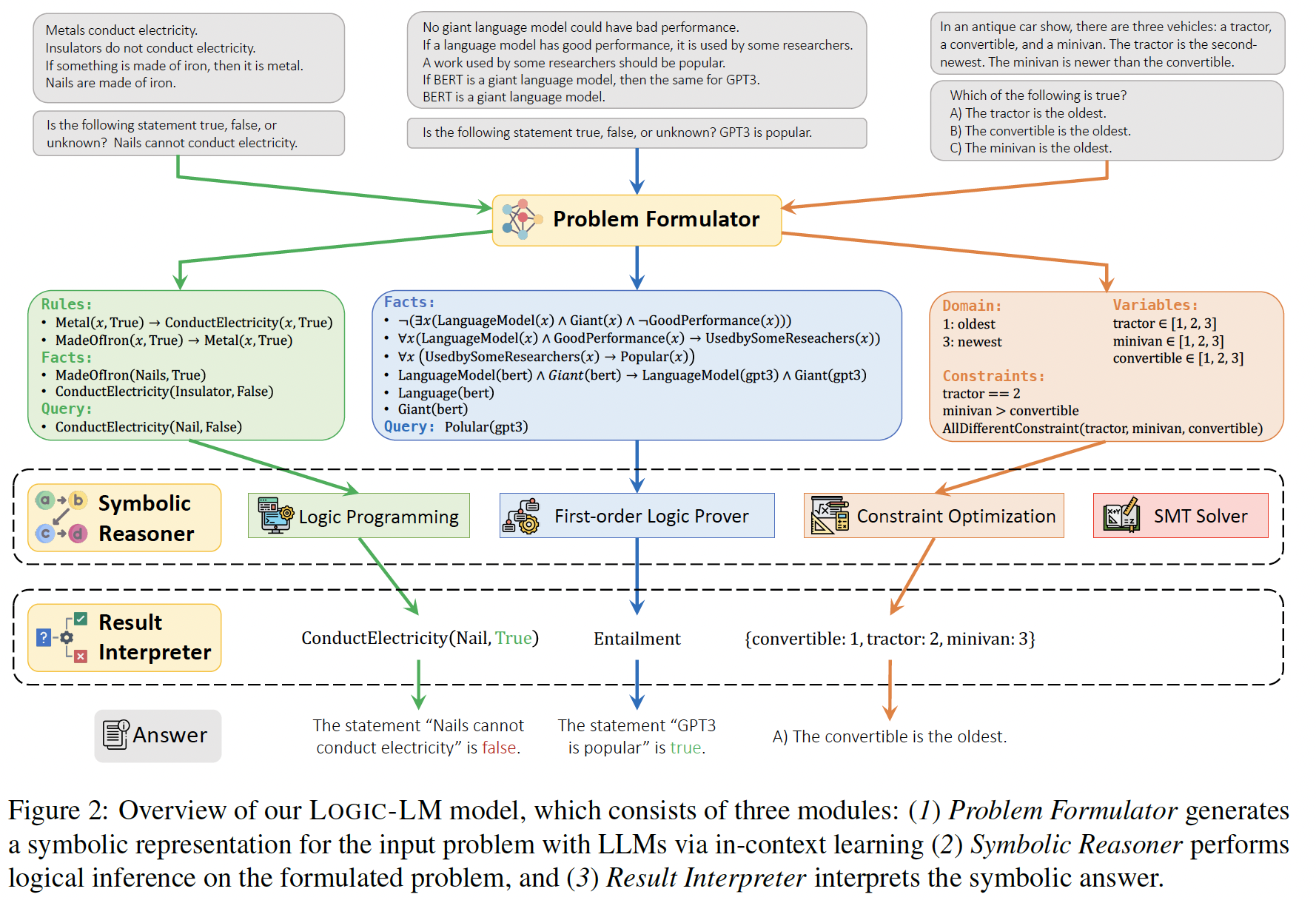
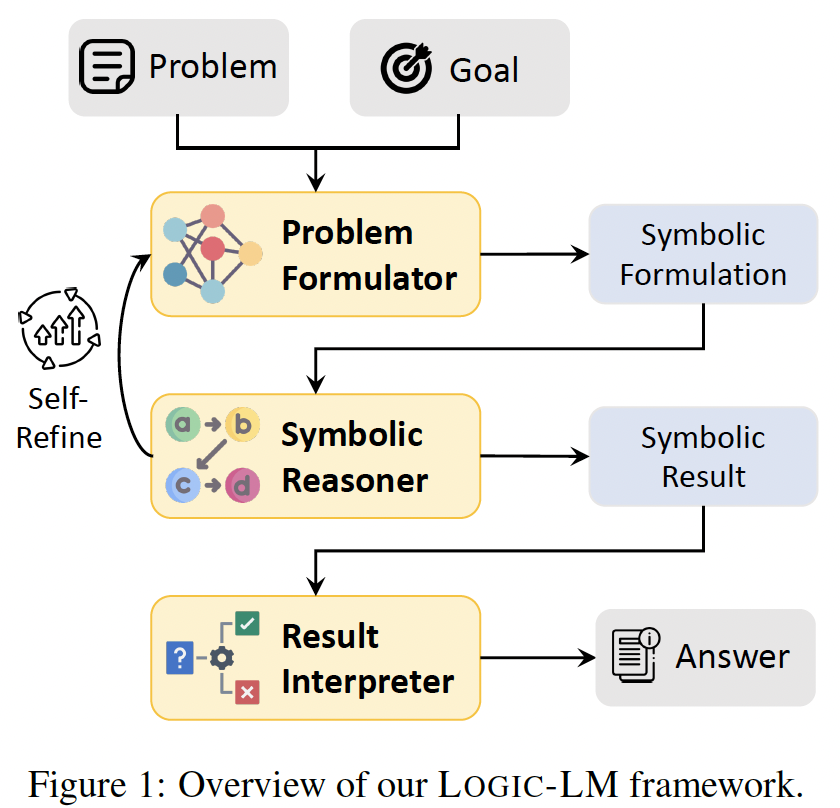
Large Language Models (LLMs) have shown human-like reasoning abilities but still struggle with complex logical problems. This paper introduces a novel framework, LOGICLM, which integrates LLMs with symbolic solvers to improve logical problem-solving. Our method first utilizes LLMs to translate a natural language problem into a symbolic formulation. Afterward, a deterministic symbolic solver performs inference on the formulated problem. We also introduce a self refinement module, which utilizes the symbolic solver’s error messages to revise symbolic formalizations.
Language Models for Logical Reasoning. Recent works in adapting LLMs for logical reasoning tasks can be broadly categorized into two groups: 1) fine-tuning approaches that optimize LLMs’ reasoning ability through fine-tuning or training specialized modules (Clark et al., 2020; Tafjord et al., 2022; Yang et al., 2022), and 2) in-context learning approaches that design special prompts to elicit LLMs’ step-by-step reasoning capabilities. Typical methods include chain-of-thought prompting (Wei et al., 2022b; Wang et al., 2023) that generates explanations before the final answer and the least-to most prompting (Zhou et al., 2023) that breaks the problem down into simpler components that can be solved individually. Both the above approaches perform reasoning directly over natural language (NL), providing greater flexibility than symbolic based reasoning. However, the intrinsic complexity and ambiguity of NL also bring undesired issues such as unfaithful reasoning and hallucinations.
we use symbolic language as the basic unit of reasoning. This effectively transfers the burden of executing complex, precise reasoning from LLMs to more reliable, interpretable external symbolic solvers. Simultaneously, we leverage the strong in-context learning ability of LLMs to formulate the NL-based problem into suitable symbolic representations, thus maintaining the benefit of flexibility.