Neurosymbolic AI- Why, What, and How
Abstract—Humans interact with the environment using a combination of perception - transforming sensory inputs from their environment into symbols, and cognition - mapping symbols to knowledge about the environment for supporting abstraction, reasoning by analogy, and long-term planning. Human perception-inspired machine perception, in the context of AI, refers to large-scale pattern recognition from raw data using neural networks trained using self-supervised learning objectives such as next-word prediction or object recognition. On the other hand, machine cognition encompasses more complex computations, such as using knowledge of the environment to guide reasoning, analogy, and long-term planning. Humans can also control and explain their cognitive functions. This seems to require the retention of symbolic mappings from perception outputs to knowledge about their environment. For example, humans can follow and explain the guidelines and safety constraints driving their decision-making in safety-critical applications such as healthcare, criminal justice, and autonomous driving. While datadriven neural network-based AI algorithms effectively model machine perception, symbolic knowledge-based AI is better suited for modeling machine cognition.
Introduction. Neurosymbolic AI refers to AI systems that seek to integrate neural network-based methods with symbolic knowledgebased approaches. We present two perspectives to understand the need for this combination better: (1) algorithmic-level considerations, e.g., ability to support abstraction, analogy, and long-term planning. (2) application-level considerations in AI systems, e.g., enforcing explainability, interpretability, and safety. Algorithm-Level Considerations Researchers have identified distinct systems in the human brain that are specialized for processing information related to perception and cognition. These systems work together
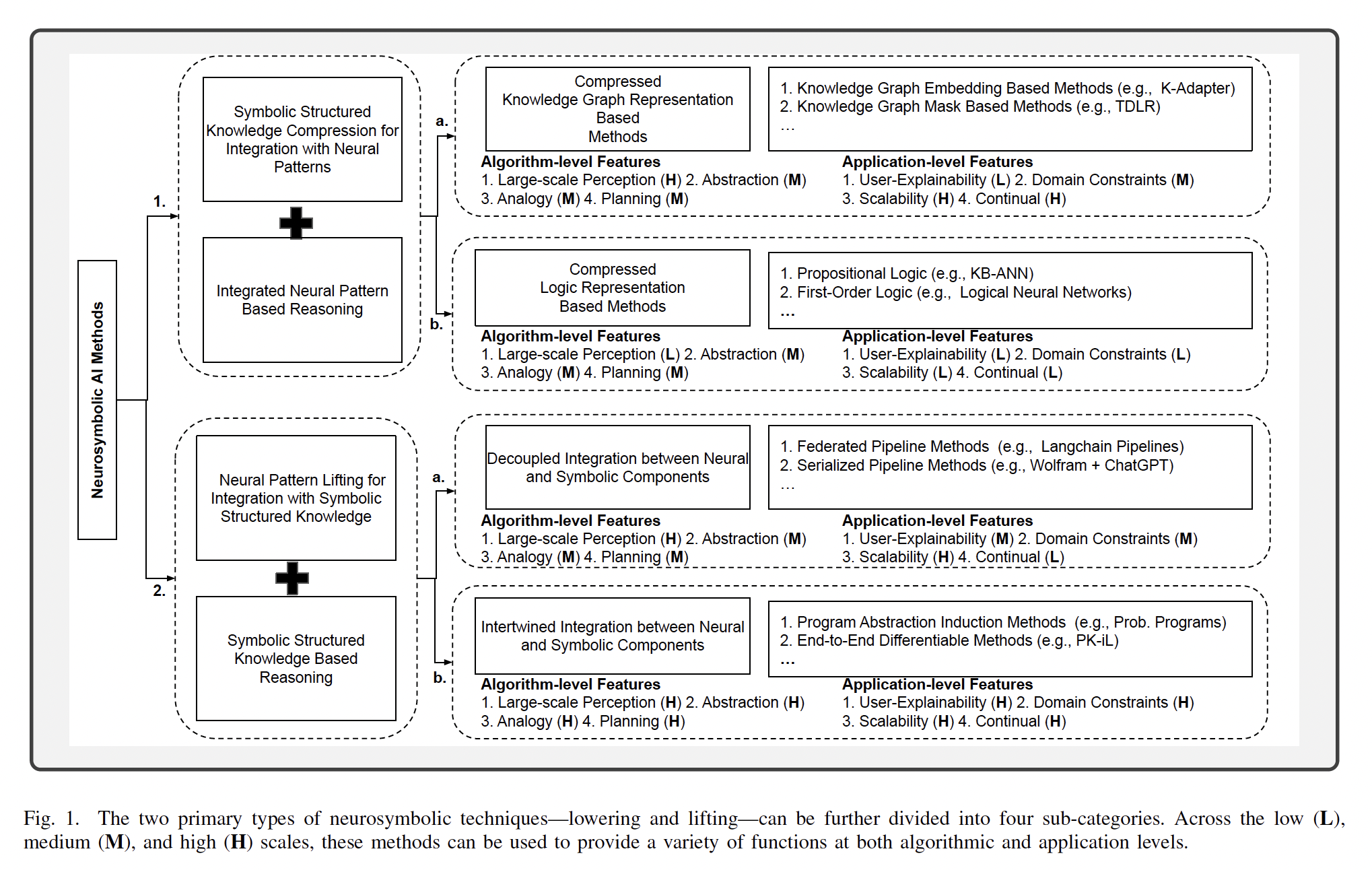
Discussion / Conclusion. In this article, we compared different neurosymbolic architectures, considering their algorithm-level aspects, which encompass perception and cognition, and application-level aspects, such as user-explainability, domain constraint specification, scalability, and support for continual learning. The rapid improvement in language models suggests that they will achieve almost optimal performance levels for largescale perception. Knowledge graphs are suitable for symbolic structures that bridge the cognition and perception aspects because they support real-world dynamism. Unlike static and brittle symbolic logics, such as first-order logic, they are easy to update. In addition to their suitability for enterpriseuse cases and established standards for portability, knowledge graphs are part of a mature ecosystem of algorithms that enable highly efficient graph management and querying. This scalability allows for modeling large and complex datasets with millions or billions of nodes.