KETOD: Knowledge-Enriched Task-Oriented Dialogue
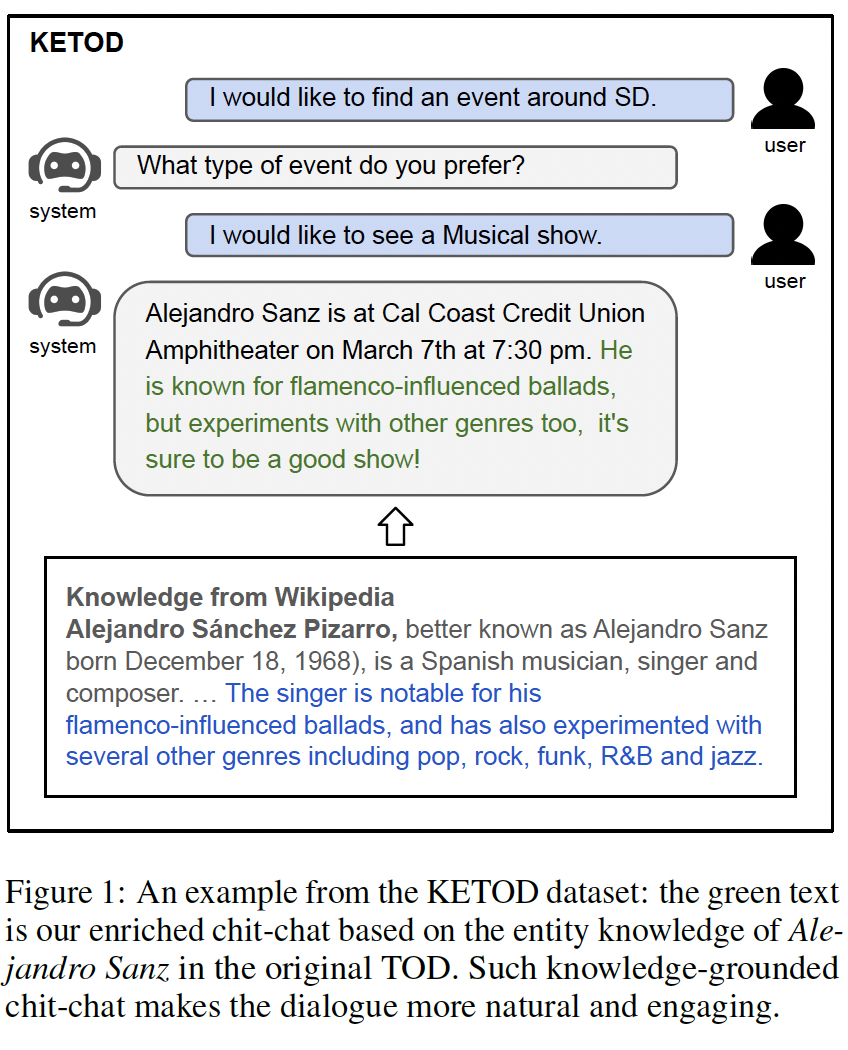
Existing studies in dialogue system research mostly treat task-oriented dialogue and chitchat as separate domains. Towards building a human-like assistant that can converse naturally and seamlessly with users, it is important to build a dialogue system that conducts both types of conversations effectively. In this work, we investigate how task-oriented dialogue and knowledge-grounded chit-chat can be effectively integrated into a single model. To this end, we create a new dataset, KETOD (Knowledge-Enriched Task-Oriented Dialogue), where we naturally enrich taskoriented dialogues with chit-chat based on relevant entity knowledge. We also propose two new models, SimpleToDPlus and Combiner, for the proposed task. Experimental results on both automatic and human evaluations show that the proposed methods can significantly improve the performance in knowledge-enriched response generation while maintaining a competitive task-oriented dialog performance. We believe our new dataset will be a valuable resource for future studies. Our dataset and code are publicly available1.
Introduction. Dialogue systems have achieved substantial progress (Zhang et al., 2020; Hosseini-Asl et al., 2020a; Tao et al., 2021) due to recent success in language model pre-training (Radford et al., 2019; Raffel et al., 2020; Lewis et al., 2020). One major type of dialogue being studied is task-oriented dialogue (TOD) (Wen et al., 2017a; Budzianowski et al., 2018; Rastogi et al., 2020; Hosseini-Asl et al., 2020a), where the system aims to collect user intents/goals to complete certain tasks (e.g. restaurant-booking). In most of TOD systems, the system responses are concise and templated, as we only focus on the success of task completion but not providing a natural and engaging conversational experience. The latter is the target of another kind of popularly studied dialogue - knowledgegrounded chit-chat (Ghazvininejad et al., 2018; Zhang et al., 2018; Tuan et al., 2019; Dinan et al., 2019).
Discussion / Conclusion. In this work, we propose to combine task-oriented dialogue with knowledge-grounded chit-chat, and construct a new dataset named KETOD, with manually composed knowledge-enriched system re- sponses. We conduct comprehensive experiments on our new dataset to study the insights and challenges. We believe that our proposed task is an important step towards the ultimate goal to build a unified, human-like conversational AI. Our new dataset KETOD, annotated by experts, will greatly facilitate the research in this direction.