Neural Topic Modeling of Psychotherapy Sessions
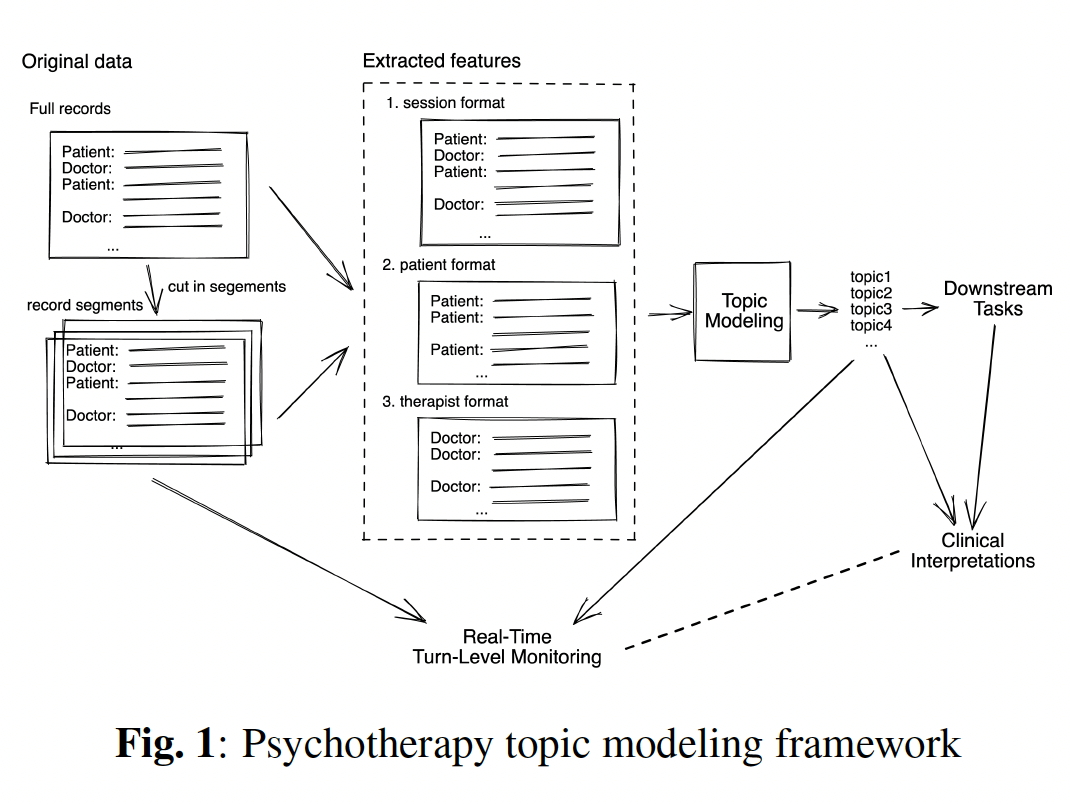
In this work, we compare different neural topic modeling methods in learning the topical propensities of different psychiatric conditions from the psychotherapy session transcripts parsed from speech recordings. We also incorporate temporal modeling to put this additional interpretability to action by parsing out topic similarities as a time series in a turn-level resolution. We believe this topic modeling framework can offer interpretable insights for the therapist to optimally decide his or her strategy and improve psychotherapy effectiveness.
Introduction. Mental health remains an issue in all countries and cultures across the globe. According to the National Institute of Mental Health (NIMH), nearly one in five U.S. adults live with a mental illness (52.9 million in 2020). One of the major causes of the mental illness is depression [1], followed by suicide which is the second cause of death among young people [2]. It is clear that there is a need for new innovative solutions in this domain. Psychotherapy is a term given for treating mental health problems by talking with a mental health provider such as a psychiatrist or psychologist[3]. To reduce the workload on mental health provider, natural language processing (NLP) is more and more adopted [4]. Noting that psychotherapy has been the first discipline using NLP. It started with a chat bot ELIZA[5] capable of mimicking a psychotherapist. Another chatbot, Parry [6], was able of simulating an individual with Schizophrenia. Natural language processing including topic modeling has shown interesting results on mental illness detection.
Discussion / Conclusion. In this work, our first goal is to compare different neural topic modeling methods in learning the topical propensities of different psychiatric conditions. We first observe that different measures of the coherence gives different rankings of the topic models, but there are a few topic models that perform relatively well across metrics. For instance, Wasserstein Topic Models and Embedded Topic Models both yield relatively high topic coherence and diversity. Our second goal is to parse topics in different segments of the session, which allows us to incorporate temporal modeling and add additional interpretability. For instance, these allows us to notice that the session trajectories of the patient and therapist are more separable from one another in anxiety and depression sessions, but more entangled in the schizophrenia sessions. This is the first step of a potential turn-level resolution temporal analysis of topic modeling. We believe this topic modeling framework can offer interpretable insights for the therapist to improve the psychotherapy effectiveness.