Learning to Ask Appropriate Questions in Conversational Recommendation
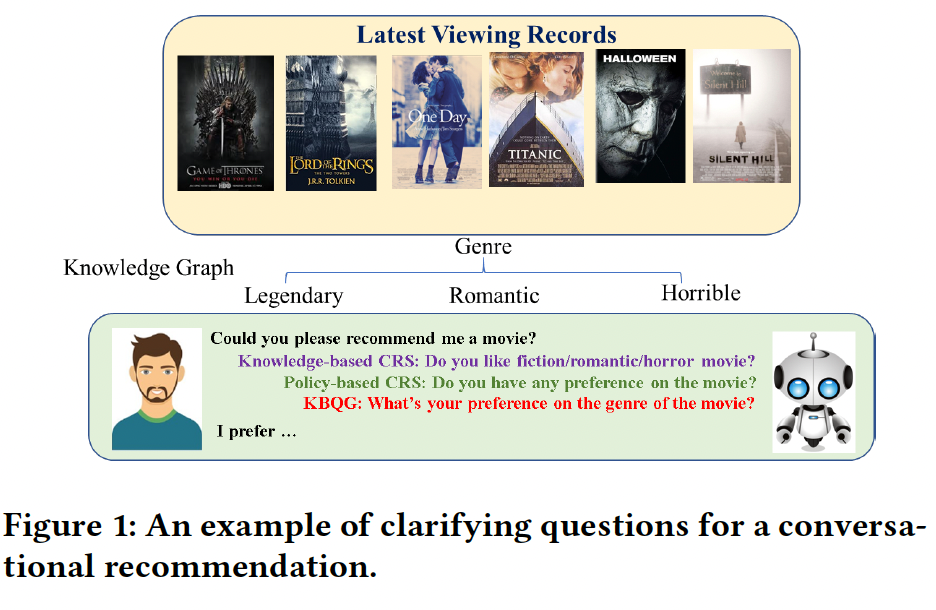
Conversational recommender systems (CRSs) have revolutionized the conventional recommendation paradigm by embracing dialogue agents to dynamically capture the fine-grained user preference. In a typical conversational recommendation scenario, a CRS firstly generates questions to let the user clarify her/his demands and then makes suitable recommendations. Hence, the ability to generate suitable clarifying questions is the key to timely tracing users’ dynamic preferences and achieving successful recommendations. However, existing CRSs fall short in asking high-quality questions because: (1) system-generated responses heavily depends on the performance of the dialogue policy agent, which has to be trained with huge conversation corpus to cover all circumstances; and (2) current CRSs cannot fully utilize the learned latent user profiles for generating appropriate and personalized responses. To mitigate these issues, we propose the Knowledge-Based Question Generation System (KBQG), a novel framework for conversational recommendation. Distinct from previous conversational recommender systems, KBQG models a user’s preference in a finer granularity by identifying the most relevant relations from a structured knowledge graph (KG).
Introduction. With personalized recommendation services, e-commerce platforms can easily infer users’ preference and generate personalized recommendations based on their interactions with the platform (e.g., searching, reviewing, and purchasing) [18]. Despite the great success achieved, traditional recommender systems are inevitably constrained by its requirement on the passively collected user feedback. This brings information asymmetry between users and recommender systems, as the system can only recommend items based on a user’s history instead of her/his real-time intent whenever the service is used [12]. Recently, the emerging language-based intelligent assistants such as Apple Siri and Google Home provide a new dimension in recommendation tasks. It enables an intelligent assistant to actively interact with users via conversations, so as to guide users to clarify their intent and find items that can meet their preferences [1]. This possibility is envisioned as a holistic composition of a dialogue agent and a recommender system, and is termed as Conversational Recommender System [12, 16].
Discussion / Conclusion. In this paper, we redefine the conversational recommender system and propose a novel KG-based conversational recommender system, KBQG, where the recommender system and the dialogue system closely cooperate with each other so as to efficiently and accurately generate recommendations in a short conversation. Specifically, the preference mining module in KBQG mainly extracts rich auxiliary information from the KG to explicitly explore users preferences from historical records. Conditioned on the explored preference, KBQG can effectively tailor the clarifying questions by priortizing attribute types that are important to the user. After multiple conversation turns, personalized recommendations will be given when the user has sufficiently clarified her/his real-time interests.