Adding Chit-Chat to Enhance Task-Oriented Dialogues
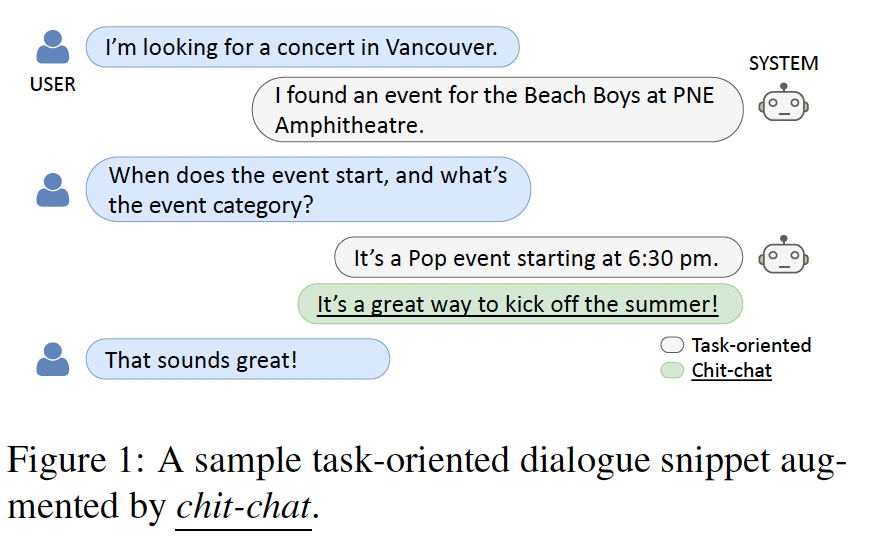
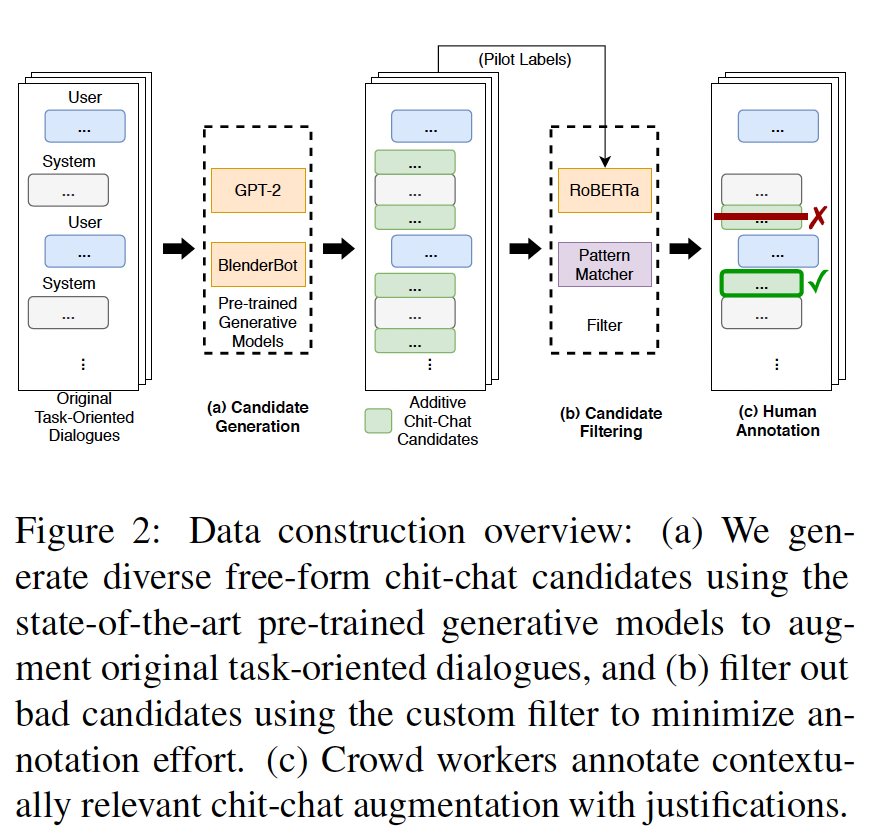
Existing dialogue corpora and models are typically designed under two disjoint motives: while task-oriented systems focus on achieving functional goals (e.g., booking hotels), open-domain chatbots aim at making socially engaging conversations. In this work, we propose to integrate both types of systems by Adding Chit-Chat to ENhance Task-ORiented dialogues (ACCENTOR), with the goal of making virtual assistant conversations more engaging and interactive. Specifically, we propose a Human ↔AI collaborative data collection approach for generating diverse chitchat responses to augment task-oriented dialogues with minimal annotation effort. We then present our new chit-chat-based annotations to 23.8K dialogues from two popular task-oriented datasets (Schema-Guided Dialogue and MultiWOZ 2.1) and demonstrate their advantage over the originals via human evaluation. Lastly, we propose three new models for adding chit-chat to task-oriented dialogues, explicitly trained to predict user goals and to generate contextually relevant chit-chat responses.
Introduction. With modeling innovations, increasing computing power, and a growing number of datasets, recent years have witnessed significant improvements in the performance of both task-oriented dialogue systems and chit-chat systems (Adiwardana et al., 2020; Roller et al., 2020; Hosseini-Asl et al., 2020; Peng et al., 2020a). Most research on dialogue systems focuses on a particular type of dialogue system. Work on task-oriented dialogue systems typically aims to track user goals with higher accuracy to better achieve functional goals (Rastogi et al., 2020) with the sacrifice of not paying explicit attention to user experience, such as making the conversation more engaging, while the latter is usually the target of research on chit-chat systems (Li et al., 2019).
Discussion / Conclusion. We propose adding chit-chat to enhance taskoriented dialogues (ACCENTOR) in this study. We present a general Human↔AI collaborative data construction approach for ACCENTOR, with which we create a dataset consisting of 23.8K chit-chat augmented task-oriented dialogues. We show via human evaluation that chit-chat augmented dialogues are preferred than the unaugmented. In addition, we propose three models for ACCENTOR. Evaluation results show that compared with the baseline trained on the original unaugmented data, our proposed models trained on the chit-chat augmented counterpart achieve a similar task performance level and higher human evaluation scores.
Lines of inquiry this paper opens 24
Research framings built by reading the notes related to this paper — the questions it feeds into.
What authorization challenges emerge when agents coordinate across system boundaries? What structural patterns sustain successful multi-turn dialogue and prevent breakdown?- What dialogue dynamics distinguish negotiation from standard information-provision tasks?
- How should dialogue state tracking change when user preferences shift mid-conversation?
- Why do comprehensive posts without uncertainty tend to suppress conversation?
- Why does context collapse pose risks in high-stakes conversations?
- What moves become possible when you represent ASR as a noisy observation model?
- How do belief distributions help systems recover from speech recognition errors?
- Why does combining natural language with numerical scores improve prediction accuracy?
- Does the same uncertainty-driven logic appear in other conversation systems?
- Can dialogue systems abstain from responding when uncertainty is too high?
- Can AI ever lead conversations without the anticipatory presence sustained attention provides?
- How does AI lose correct information under conversational persuasive pressure?
- How do training-data priors influence model defaults when context is ambiguous?
- Can explicit numerical signals override learned linguistic defaults in fine-tuned models?
- How does the silent token approach compare to modeling intrinsic motivation for speaking?
- How do models signal knowledge gaps through token probability?
- Can AI detect sense-of-nonsense the way human readers do?
- Can systems recognize and abstain on judgments rather than hallucinating preferences?