INSPIRED: Toward Sociable Recommendation Dialog Systems
we present INSPIRED, a new dataset of 1,001 human-human dialogs for movie recommendation with measures for successful recommendations. To better understand how humans make recommendations in communication, we design an annotation scheme related to recommendation strategies based on social science theories and annotate these dialogs. Our analysis shows that sociable recommendation strategies, such as sharing personal opinions or communicating with encouragement, more frequently lead to successful recommendations. Based on our dataset, we train end-to-end recommendation dialog systems with and without our strategy labels.
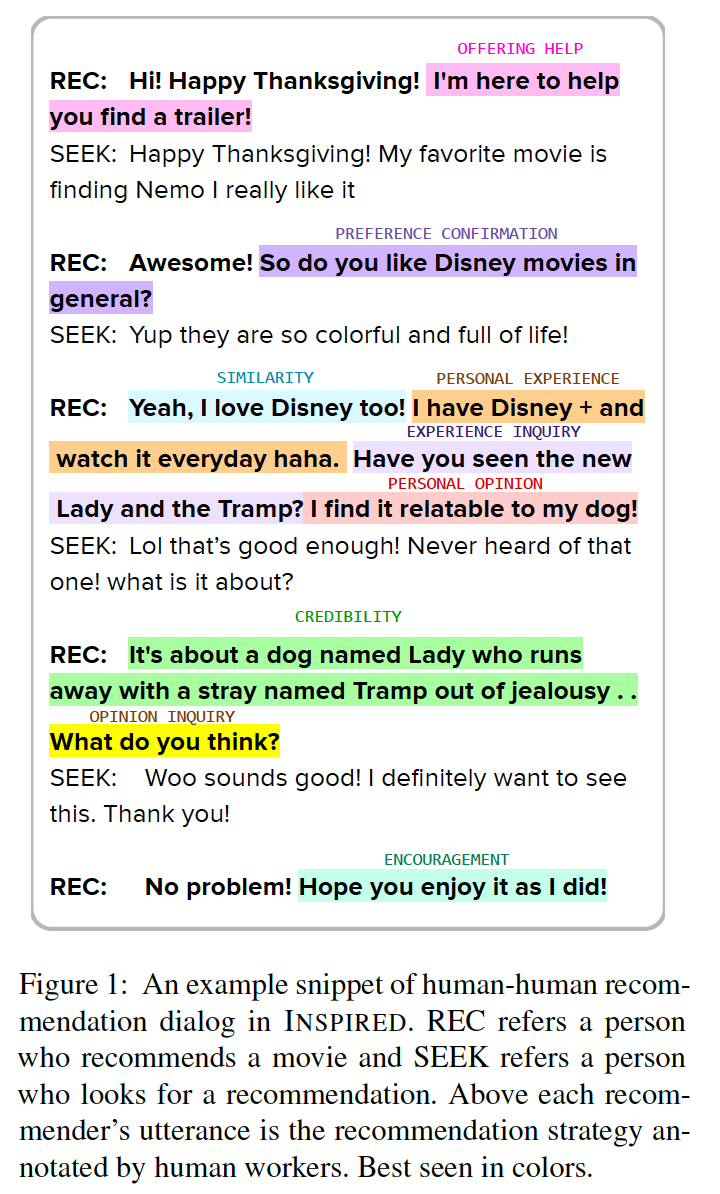
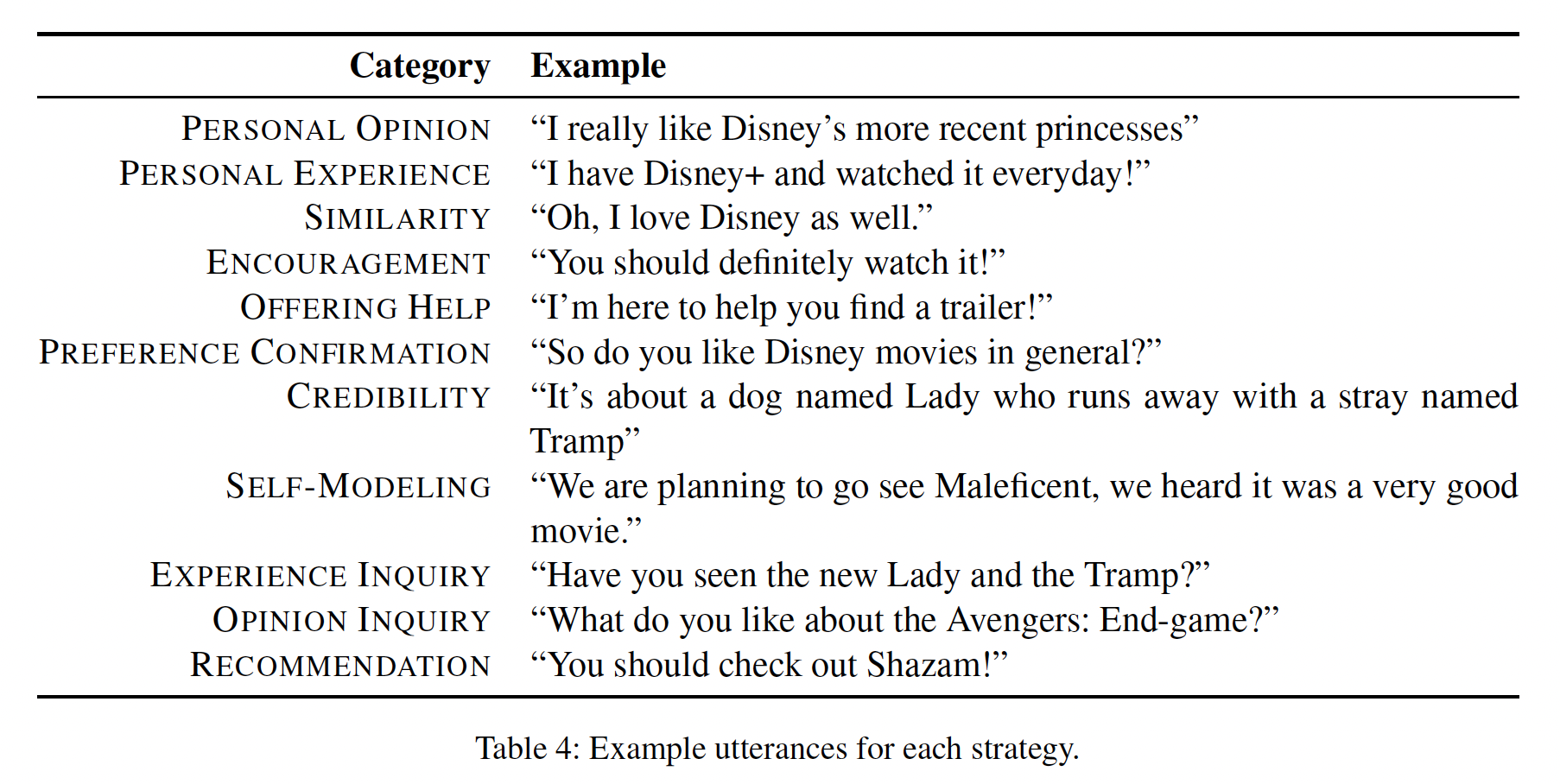
After conversations are collected, two experts, trained with linguistics background, develop an annotation scheme using content analysis method (Krippendorff, 2004) and from past study on human behavior in making recommendations. Similar approaches have been done in prior studies on work for persuasion task (Wang et al., 2019) or negotiation task (Zhou et al., 2019). We divide the recommendation strategies into two categories: sociable strategies and preference elicitation strategies. Sociable strategies are also derived from our literature study on the social science theories. Sociable strategies contain eight strategies related to the recommendation task. These strategies relate to the recommenders trying to build rapport with the seekers.
• Personal opinion refers to a condition when recommenders express their subjective opinion about a movie, including its plot, actors, or other movie attributes.
• Personal experience refers to the use of sharing personal experience related to a movie. For example, recommenders may say that they watch the movie several times to convince the seekers that the movie is good. Both personal opinion and personal experience are part of self-disclosure that leads to establishing rapport with the seekers (Altman, 1973).
• Similarity refers to a condition when the recommenders are empathizing and being like-minded toward seekers about their movie preference to produce similarity among them. Similarity is believed to influence the seekers’ liking for the source that leads to trust the recommenders’ judgment more (O’Keefe, 2004), following Lazarsfeld and Merton (1964)’s homophily theory that states humans like other people who are similar to them.
• Encouragement is the use of praise of the seekers’ movie taste and encouragement to watch a recommended movie to build rapport and promote the recommended movie.
• Offering help is a strategy when the recommenders disclose explicit intention to help the seeker or being transparent. It is a part of “transparency” strategy from Gretzel and Fesenmaier (2006).
• Preference confirmation is a strategy when the recommenders ask or rephrase the seeker’s preference. This strategy is also a part of “transparency” strategy which states that the recommenders disclose their thinking process of understanding the seekers’ preference.
• Self-modeling is a strategy when the recommender becomes a role model to do something first so that the Seeker would follow (Dowrick, 1999).
• Credibility happens when the recommender shows expertise and trustworthiness in providing information to persuade the seeker (Fogg, 2002; O’Keefe, 2004; Rhoads and Cialdini, 2002). In our study, a recommender is doing credibility appeal when they provide factual information about movie attributes, such as the plot, actors, or awards that the movie has. Preference elicitation inquiries include the following inquiries that are asked by the recommenders to know the seekers’ movie tastes.
• Experience inquiry asks for seeker’s experience on movie watching, such as whether a seeker has watched a certain movie or not.
• Opinion inquiry asks for seeker’s opinion on movie-related attributes. Example answers for this inquiry is the seeker’s explanation on what they like about the plot or if they admire the actors’ acting skill. Other kinds of utterances, such as greetings or thanks, fall into non-strategy category.
Other kinds of utterances, such as greetings or thanks, fall into non-strategy category. We also label sentences which are recommendation. Recommendation is defined as when the recommender suggests a new movie title for the first time for the seeker. 30% of the recommendation sentences are “experience inquiries”, 27% are “encouragement”, and 14% are “personal opinion”. Example annotated utterances are displayed in Table 4. Meanwhile, Table 5 shows the number of annotated utterances in INSPIRED.
Lines of inquiry this paper opens 16
Research framings built by reading the notes related to this paper — the questions it feeds into.
How should agents learn and use user preferences during conversation?- What dialogue patterns do real human recommendation conversations actually contain?
- What other conversation structures besides mention order carry predictive information for recommendation?
- Why do users naturally express recommendations critiques instead of positive preferences?
- Does transforming critiques into preferences change how conversational recommenders should decide when to ask versus recommend?
- Can preference-elicitation dialogue simulators generate sociable recommendation strategies?
- Why did conversational recommenders drop both item and user similarity signals?
- How should conversational recommender systems balance task focus with rapport building?
- What preference signals beyond reviews can improve recommendation steering?
- Why do humans accept recommendations from people they perceive as similar?
- Can sentiment-coordinated augmentation enable more sociable recommendation strategies?
- What conversational moves signal expertise and build credibility in recommendations?
- How much of conversational recommender progress comes from chasing flawed metrics?
- What would conversational recommender evaluation look like if ground truth was carefully curated?